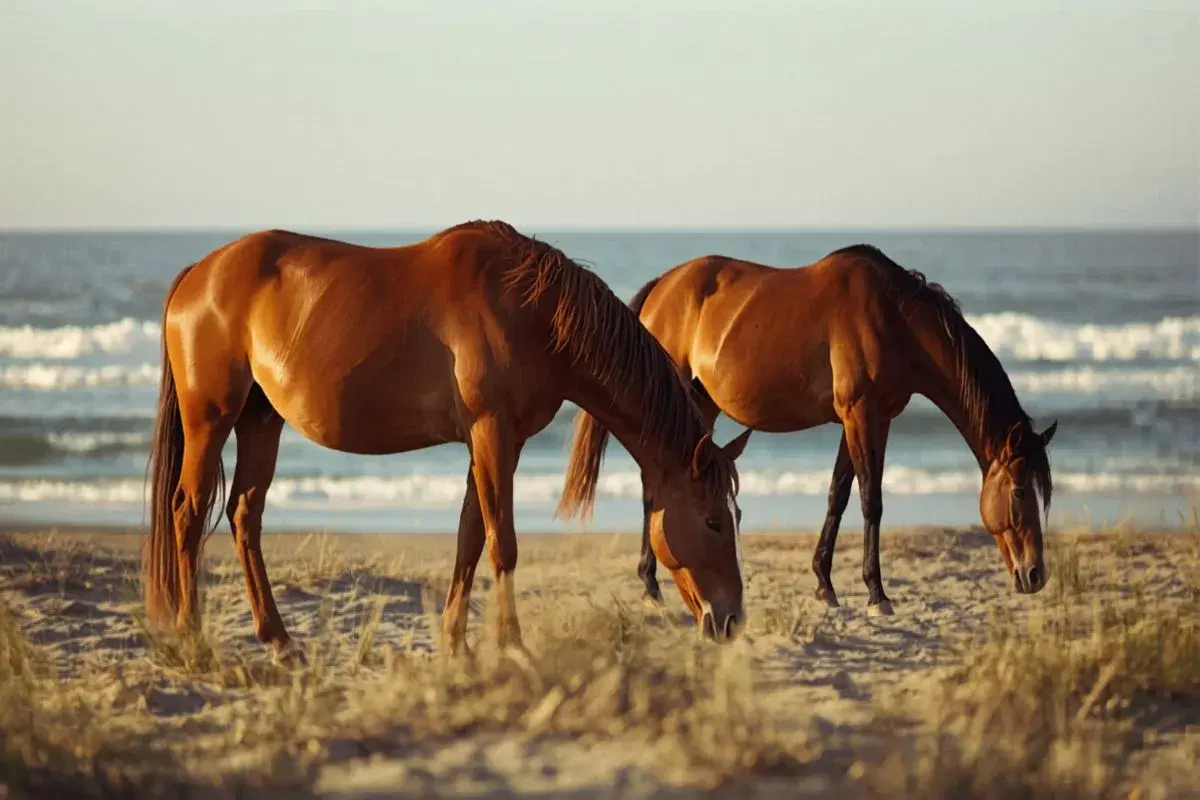
North of the town of Corolla, accessible only by 4WD vehicle, a herd of Colonial Spanish Mustangs roams freely on one of the most remote stretches of the Outer Banks. These horses have been on these beaches for over 400 years — descendants of horses brought by Spanish explorers in the 1500s — and they are genuinely wild. They live, forage, and reproduce without any human management.
Seeing them is one of those experiences that stays with people long after the trip ends.
The Horses: A Brief History
The exact origin of the Corolla wild horses is debated by historians, but the prevailing theory ties them to Spanish expeditions along the North American coast in the 1500s. Horses left behind or escaped from those expeditions established feral herds on the barrier islands, and the isolation of the Outer Banks preserved them through the centuries that followed.
The Corolla herd was once much larger — hundreds of horses roamed the northern beaches. Development through the 20th century reduced their range and pushed them north of a steel fence built in 1995 that now separates the 4WD-only area from the paved road section of Corolla. Today the herd numbers around 100 animals, managed by the Corolla Wild Horse Fund, a nonprofit dedicated to their preservation and monitoring.
These horses are genuinely wild. They are not tame, they are not fed by humans (it's actually illegal), and they can be dangerous if approached. The Fund's rangers enforce a 50-foot distance requirement and educate visitors constantly about safe wildlife interaction.
How to See the Horses
Option 1: 4WD Vehicle
The horses roam the beach and the soundside marsh north of the Corolla fence — a 15-mile stretch extending to the Virginia border at Carova Beach. You can access this area in a 4WD vehicle (all-wheel drive with low-range capability) by airing down your tires at the 4WD access ramp and driving north on the beach. Horses may appear anywhere in this stretch — on the beach, in the dunes, on the soundside, or in the scrubby vegetation areas.
Pros: Freedom to explore, no set schedule, can combine with beach time
Cons: Requires a capable 4WD vehicle; soft sand can strand unprepared vehicles
4WD vehicle rentals are available in Corolla for guests who don't have their own.
Option 2: Guided Tour (Recommended for Most Visitors)
Multiple tour operators run guided wild horse tours in lifted, open-air 4WD vehicles. Guides know the horses' movement patterns, have radio contact with other guides in the field, and provide narration about the horses' history, behavior, and conservation.
Typical tour format:
- 2-hour guided experience in a raised 4WD vehicle (6–12 passengers)
- Guides communicate to locate current horse positions
- Educational narration on herd history and conservation
- Guaranteed sightings (most tours offer to reschedule if no horses are found, which is rare)
Pricing: $40–$60 per adult, $20–$35 per child depending on operator
Reservations: Required; book 1–2 days in advance in summer, morning-of in shoulder season
Option 3: Kayak Tour
A few operators offer kayak-based wildlife tours on the soundside that encounter horses drinking or grazing at the water's edge. This is a quieter, more intimate encounter and a genuinely memorable experience, though sightings are less predictable.
Tour Operators
- Corolla Wild Horse Tours — The original tour company; excellent guides with deep local knowledge
- Wild Horse Adventure Tours — Open-air 4WD tours with educational focus; good for families with kids
- Kitty Hawk Kites — Occasional wild horse kayak tours from their Corolla location
Book directly with the operator; phone reservations are typically fastest in peak season.
Tips for Your Tour
Bring binoculars. Even at the legal 50-foot minimum distance, binoculars allow you to see facial expressions, foal behavior, and herd dynamics you'd miss with the naked eye.
Go early in the morning. Horses are most active in early morning and late afternoon. Morning tours typically have calmer conditions and better wildlife activity.
Expect to wait. Finding the horses requires driving and searching. Part of the experience is the search. Guides are skilled at locating the herd, but wildlife doesn't follow a schedule.
Dress in layers. The northern 4WD beach is exposed to Atlantic wind year-round. Even on a warm summer day, the beach can be significantly cooler than Corolla proper. A light jacket is wise.
Don't feed, touch, or approach the horses. This isn't just a rule — it's the right thing to do. These horses have survived 400 years without human food. Feeding them harms their digestion and habituates them to humans in ways that cause dangerous encounters.
Respect the Corolla Wild Horse Fund. The Fund's work is essential to the herd's survival. Consider supporting their conservation work at corollawildhorses.com.
Can You Bring Dogs on a Wild Horse Tour?
Most guided tour vehicles do not allow dogs due to the enclosed nature of the vehicle and the potential to disturb the horses. If you're traveling with dogs, the self-drive 4WD option allows dogs in your personal vehicle, though you must keep them secured and well away from the horses.
Grandy Cove welcomes up to 2 dogs and is 30–40 minutes from the Corolla 4WD access ramp — a convenient base for a wild horse day trip.
Getting to Corolla from Grandy Cove
Corolla is approximately 30–40 minutes north of Grandy. Take US-158 East to NC-168 North to NC-12 North into Corolla. Tour operators are clustered in the Corolla Light Town Center area near the lighthouse.
Check availability and book your OBX stay — Grandy Cove is the closest waterfront rental to the Corolla wild horse area on the sound side.