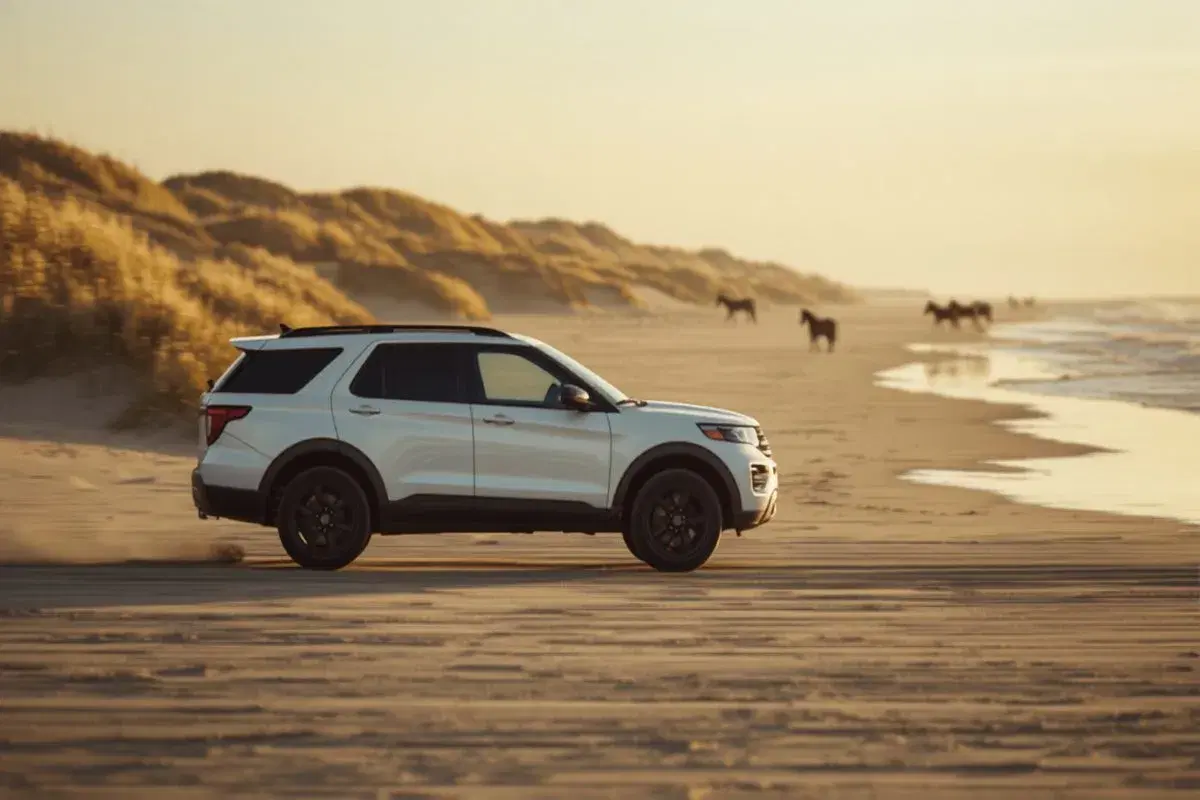
About 11 miles north of Grandy, the paved highway through Corolla simply ends. There's a ramp, a stretch of soft sand, and then nothing but open beach running another 11 miles to the Virginia line. This is the 4x4 area — Swan Beach, North Swan Beach, and Carova — and the beach itself is a legally designated public road. It's also the only place on the East Coast where you can drive your own vehicle out to see a herd of wild Colonial Spanish Mustangs grazing in the dunes.
You don't need a guided tour to do this. With a true four-wheel-drive vehicle, the right tire pressure, and a little preparation, the self-drive trip is one of the best half-day adventures on the Outer Banks — and from Grandy Cove it's a straightforward 35–45 minute drive to the ramp. Here's everything you need to know before you point your tires north.
Where the Pavement Ends and the Beach Begins
The 4x4 access ramp is at the very north end of NC Highway 12 in Corolla, just past the Currituck Beach Lighthouse and the Whalehead/Historic Corolla Park area. Follow Highway 12 north until it dead-ends at the beach access. There's a small parking area, an air station nearby, and the ramp down onto the sand.
Once you're on the beach, you're driving on a public road governed by real rules. The beach is the road — there are no streets behind the dunes for most of the area, just sandy two-track lanes serving the scattered houses of Carova. People live up here year-round, kids play, and the horses have right of way. Treat it like a neighborhood, because it is one.
The three communities, south to north:
- Swan Beach — the first stretch north of the ramp, closest to Corolla
- North Swan Beach — a quieter middle section
- Carova — the northernmost community, running up to the Virginia border (you cannot drive across into Virginia; False Cape State Park blocks vehicle access at the line)
What Kind of Vehicle You Actually Need
This is the part people get wrong. You need a true four-wheel-drive or all-wheel-drive vehicle with real ground clearance — a Jeep, 4Runner, Tahoe, Bronco, F-150 4x4, or similar. A front-wheel-drive crossover or a car will get stuck, and getting towed off the sand is expensive and embarrassing.
A few hard requirements:
- 4WD/AWD that you can actually engage — know how to put your specific vehicle into four-wheel drive before you leave
- Decent ground clearance — soft sand and washouts after storms can be deep
- A vehicle you don't mind getting salty — saltwater spray and sand are hard on undercarriages; rinse it afterward
If you're driving a rental car or a two-wheel-drive vehicle, do not attempt the 4x4 beach. Book a guided wild horse tour from Corolla instead — the outfitters run lifted, open-air trucks built for exactly this, and a local guide knows where the herd has been moving.
Airing Down: The Single Most Important Step
The number one cause of stuck vehicles is driving onto soft sand with highway tire pressure. Lower your tire pressure before you get on the beach. Dropping the PSI widens the tire's footprint, lets it float over soft sand instead of digging in, and dramatically improves traction.
- Target pressure: roughly 18–20 PSI for most vehicles (lighter vehicles can go a little lower; check what's safe for your tires)
- Air down at the station near the ramp before you drive on, or carry a portable gauge and deflator
- Air back up at the same station when you leave — driving on pavement with deflated tires is unsafe and damages them
Carry a few essentials in case you do get into trouble: a tow strap, a small shovel, and a board or traction mat. Cell service is spotty to nonexistent in Carova, so don't count on calling for help.
The Rules of the 4x4 Beach
Currituck County enforces these, and the fines are real:
- Speed limit is 15 mph near homes and pedestrians, 35 mph max where posted on the open beach
- Stay 50 feet away from the wild horses at all times — it is illegal to approach, touch, or feed them, with fines up to $500 per offense
- Never feed the horses anything — human food, including apples and carrots, can kill them; their digestive systems are adapted to sea oats and marsh grass
- Yield to pedestrians, horses, and oncoming traffic — the beach narrows at high tide, so check the tide chart before you go
- No driving on the dunes or vegetation — stay on the hard-packed sand and established lanes
- Pack out everything — there's no trash service on the beach
- Driving is restricted seasonally in parts of Corolla south of the ramp (May–September daytime closures), but the 4x4 area north of the ramp is open year-round
Timing It Right: Tides and the Horses
The single best piece of advice for a self-drive trip is to go at lower tide. The band of hard, drivable sand is widest when the tide is out; at high tide the beach can pinch down to a narrow strip with soft sand and surf on both sides. Check a Carova/Corolla tide chart and aim to be driving in the few hours around low tide.
The horses roam free across the whole 4x4 area and don't keep a schedule, but you'll often find them in the cooler parts of the day — early morning and late afternoon — grazing in the dune grass behind the houses rather than out on the open beach. Drive slowly, keep your eyes on the dune line, and when you spot them, stop, stay in or beside your vehicle, and keep your distance. A zoom lens or phone zoom gets you the photo without breaking the 50-foot rule.
These are not tame animals. They're the descendants of Spanish horses that have lived wild on this barrier island for roughly 500 years, and they are genuinely unpredictable. Admire them as wildlife, not as a petting zoo.
A Simple Self-Drive Itinerary from Grandy
A relaxed half-day from Grandy Cove looks like this:
- Leave mid-morning or mid-afternoon to line up with low tide (check the chart the night before)
- Drive to Corolla — about 35–45 minutes north via Highway 12, past the lighthouse
- Air down at the station near the ramp to ~18–20 PSI
- Drive onto the beach and head north into Swan Beach and Carova at a slow, steady pace
- Find a spot to park on the hard sand, walk down to the water, and let the kids and dogs stretch — the Carova beaches are dog-friendly and far emptier than the central OBX
- Watch the dune line for horses on the way up and back
- Air back up at the station before returning to pavement
- Rinse the salt off your vehicle when you're home
Bring more water and snacks than you think you need, sun protection, and a full tank of gas — there are no services, stores, or restrooms in the 4x4 area.
Why This Is Easier from the Northern Gateway
Most visitors who want to see the wild horses are staying down in Kill Devil Hills or Nags Head, which turns this into a 60–90 minute drive each way just to reach the ramp. Basing your trip in Grandy — the northern mainland gateway to the Outer Banks — cuts that in half. You're already on the north end, so the 4x4 beach, the Currituck Beach Lighthouse, and the quieter Corolla side of the OBX are all close at hand.
Grandy Cove sits directly on Currituck Sound with a private dock and boat launch, sleeps six across three bedrooms, and welcomes up to two dogs with no size restrictions — so the same trip that takes you to the wild horses in the morning can end with crabbing off the dock at sunset. For more on exploring the north end, see our Corolla area guide and our guide to OBX with kids.
Ready to plan your wild horse adventure? Check availability and book direct — no platform fees, and you'll be staying minutes from the ramp.