On December 17, 1903, Orville Wright lay flat on the lower wing of a wooden biplane, gripped the controls, and held on while his brother Wilbur ran alongside. Twelve seconds and 120 feet later, human-powered flight existed. It happened on a sand dune in what is now Kill Devil Hills, North Carolina — roughly 30 minutes south of Grandy Cove.
The Wright Brothers National Memorial preserves the exact spot, the reconstructed camp buildings, the field where the four 1903 flights took place, and a full-scale flight room exhibit. It is one of the most quietly powerful National Park sites on the East Coast — and one of the easiest to visit on an OBX trip.
Here is everything you need to know before you go.
Where It Is and How to Get There
The visitor center sits at 1000 North Croatan Highway, Kill Devil Hills, NC 27948, at roughly milepost 7.5 on the US-158 Bypass. The entrance is on the west (sound) side of the bypass — not the beach side.
A note on the address: the park's mailing address is 1401 National Park Drive, Manteo — the shared headquarters for the Outer Banks Group of national park sites. Type that into your GPS and you will end up on Roanoke Island, roughly 30 minutes from where you meant to go. Use the Croatan Highway address above.
From Grandy Cove, it is a straight 25–30 minute drive south on US-158, crossing the Wright Memorial Bridge into Kitty Hawk and continuing south. The memorial is visible from the bypass — you cannot miss the 60-foot granite pylon on top of Kill Devil Hill.
Parking: Free, ample lot directly at the visitor center. RVs and trailers welcome.
Entry Fees and Hours
- Entry fee: $10 per person, ages 16 and over. Free for kids 15 and under.
- Annual pass for this site: $35, which admits the holder plus up to three additional visitors 16 and over
- America the Beautiful pass holders: Free
- Hours: Open year-round, 9 AM to 5 PM daily. Closed Christmas Day.
The fee is per person, not per vehicle. This is the single thing visitors get wrong most often. A carload of four adults pays $40, not $10. If there are more than three adults in your group, or you expect to come back during your stay, the $35 annual site pass pays for itself immediately.
The park does not accept cash. Bring a credit or debit card for the entrance kiosk, or buy your pass ahead of time on recreation.gov.
For $10 a head you get the visitor center, the museum, the reconstructed camp buildings, the flight line markers, the granite monument hike, and (most days) a ranger talk in the flight room — still one of the better values in the National Park system.
Free Admission Days
The memorial waives entrance fees on the standard National Park Service fee-free days, plus two of its own that no other park observes:
- August 19 — National Aviation Day
- December 17 — the anniversary of the first flight
The National Park Service fee-free days for 2026 are February 16 (Presidents Day), May 25 (Memorial Day), June 14 (Flag Day), July 3–5 (Independence Day weekend), August 25 (the Park Service's 110th birthday), September 17 (Constitution Day), October 27 (Theodore Roosevelt's birthday), and November 11 (Veterans Day).
As of late September 2026, that leaves October 27, November 11, and December 17 on the calendar this year.
One important change to know about: starting in 2026, fee-free days apply only to US citizens and permanent residents. Nonresident visitors pay the regular entrance fee on those dates.
What to See — In the Order You Should See It
The site is laid out so you can walk through the entire story in roughly two hours. Here is the most rewarding sequence:
1. Visitor Center and Museum (start here)
The visitor center reopened in 2018 after a multi-year renovation. The museum is small but excellent — original Wright artifacts, a full-size reproduction of the 1903 Wright Flyer suspended in the flight room, and detailed exhibits on how two bicycle mechanics from Ohio solved a problem that had defeated everyone before them.
Plan for 30–45 minutes here. Don't skip the short film if it's running.
2. The Flight Room Ranger Talk
Several times a day, a park ranger gives a 30-minute talk standing next to the full-scale Flyer reproduction. This is the single best thing at the memorial. Rangers explain wing warping, the wind tunnel experiments, why the brothers chose Kitty Hawk over Ohio (steady wind, soft sand, isolation), and what actually happened on the morning of December 17, 1903.
Check the schedule at the front desk when you arrive — talks are usually around 10:30 AM, 12 PM, 2 PM, and 3:30 PM but vary by season.
3. The Flight Line and Camp Buildings
Outside the visitor center, four numbered granite markers trace the exact path and length of each of the four flights on December 17, 1903 — 120 feet, 175 feet, 200 feet, and the famous fourth flight of 852 feet that lasted 59 seconds. Walking the actual distances is more affecting than the numbers suggest. The third marker (200 feet) is roughly the length of a high school basketball court. The fourth marker (852 feet) is across an open field — by 1903 the Wrights had already pushed their machine nearly three football fields through the air.
Beyond the markers are two reconstructed buildings: the hangar (where the Flyer was stored and assembled) and the living quarters (where Orville and Wilbur slept, ate, and waited out the weather during their field seasons). Both are open to walk through.
Worth knowing while you stand in there: the engine that made the 1903 flight possible was built by the brothers' Dayton machinist, Charlie Taylor, who turned it out in roughly six weeks when no manufacturer would take the job. Taylor never came to Kitty Hawk — he stayed behind in Ohio and never saw the camp or the flights he made possible.
4. The Granite Monument on Kill Devil Hill
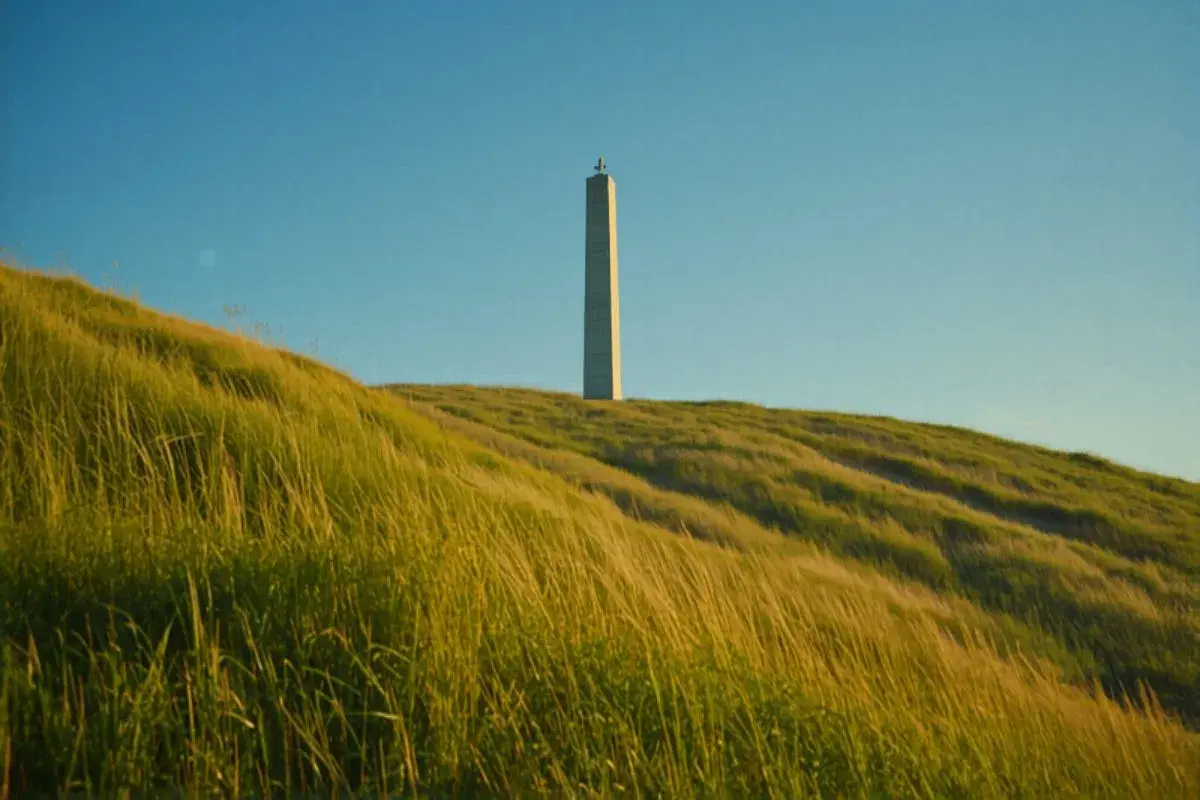
The 60-foot granite pylon at the top of Kill Devil Hill is the iconic image of the memorial. The hill itself is a 90-foot-tall stabilized sand dune — the one the Wrights used for their unpowered glider flights in 1900, 1901, and 1902 before the powered Flyer ever existed.
The walk up is paved, gradual, and takes about 10–15 minutes. From the top, the view sweeps across Albemarle Sound to the west and the Atlantic to the east on a clear day. The monument's inscription reads: "In commemoration of the conquest of the air by the brothers Wilbur and Orville Wright. Conceived by genius. Achieved by dauntless resolution and unconquerable faith."
The pylon's sides carry outspread wings in bas-relief, which is easy to miss from directly below — step back toward the base of the hill to see the bird shape the 1932 designers were going for.
Stroller and wheelchair note: The main grounds — visitor center, camp buildings, and flight line markers — are paved and level, which makes this one of the more genuinely accessible historic sites on the Outer Banks. The path up the hill to the monument is paved but does climb steadily. The Park Service does not publish detailed grade information; if the climb is a question for your group, call the park at (252) 473-2111 or ask at the front desk when you arrive, and rangers will walk you through the options. Our wheelchair-accessible OBX guide covers how the memorial fits into a wider accessible trip.
5. The First Flight Boulder
A small granite boulder near the visitor center marks the exact spot where the Flyer left the ground on the first flight. It is easy to miss — look for it on the path between the visitor center and the flight line markers. Most visitors walk past it without noticing.
6. The First Flight Centennial Sculpture
On the south end of the grounds is a full-scale sculpture of the moment itself, commissioned by the State of North Carolina for the 2003 centennial. The Flyer is a stainless steel replica with a 40-foot wingspan, surrounded by seven life-size bronze figures: Orville flat on the lower wing, Wilbur running at the wingtip, and John T. Daniels — a surfman from the Kill Devil Hills Life-Saving Station — at the camera.
Daniels squeezed the bulb on the most famous photograph in aviation history. It was the first photograph he had ever taken in his life.
The other four figures are the rest of the men who happened to be there that morning: Adam Etheridge, Will Dough, Johnny Moore, and Cephus Brinkley. They were added two years after the rest, and dedicated on December 17, 2005.
Visitors are meant to walk into this one rather than around it — you can stand in Wilbur's place at the wingtip, which is the best photograph most people take all day.
How Long to Plan For
- Quick visit: 1 hour (museum + monument hike, skip the ranger talk)
- Standard visit: 2 hours (everything except the south end sculpture)
- Full visit: 2.5–3 hours (ranger talk, museum, all outdoor markers, monument, sculpture, gift shop)
Most visitors are surprised how much there is to see. Plan for at least 2 hours.
Best Time to Visit
- Early morning (9–10 AM): Smallest crowds, best light for photos at the monument
- Late afternoon (3–4 PM): Golden light on the granite pylon, often a great ranger talk window
- Avoid: Summer weekends between 11 AM and 2 PM — the parking lot fills and the flight room gets crowded for talks
Best season: September through May. Summer crowds peak in June–August. Fall is genuinely the sweet spot — fewer visitors, comfortable walking weather, and the steady eastern winds that drew the Wrights to Kitty Hawk in the first place. Our fall OBX guide covers what else to do in shoulder season.
December 17: The One Day That Is Different
Every year on December 17, the memorial marks the anniversary of the first flight, and it stops being a quiet historic site for a day. In 2026 the anniversary falls on a Thursday and marks 123 years since the flight.
The Park Service builds a program around it. In past years that has meant a wreath-laying ceremony at the original flight site, a flyover, a formal program with a keynote speaker, appearances by Wright family descendants, and extra ranger talks through the afternoon. Entrance is free that day.
Two things make the 2026 anniversary worth planning around rather than stumbling into. It lands in America's 250th year, and Dare County has spent all of 2026 running history programming under the Dare A250 banner — the First Flight anniversary is the natural capstone to it. Our guide to what's left of America's 250th on the Outer Banks covers the rest of that calendar.
The practical consequence: expect a bigger crowd than a normal December. Arrive early, and check nps.gov/wrbr for the published schedule closer to the date rather than assuming past years' timings hold.
If you want the site at its quietest instead, any other weekday in December delivers exactly that — the grounds in winter, with the wind the Wrights came here for and almost nobody else on the flight line.
What to Bring
- Water — there is no concession on site, and the monument hike has no shade
- Sun protection — most of the site is open ground with no tree cover
- Comfortable walking shoes — you'll cover roughly a mile on foot if you do the full site
- Camera with a wide lens — capturing the full pylon and the hill in one frame requires stepping back
- A credit or debit card — the park is cashless, at the entrance kiosk and inside; the visitor center bookstore has the best Wright Brothers literature anywhere and cash will not help you there either
Dogs at the Memorial
Leashed dogs are welcome on the outdoor grounds, including the path up Kill Devil Hill and the flight line markers. Dogs are not allowed inside the visitor center or the reconstructed camp buildings. There are no dedicated water stations, so bring a collapsible bowl. If you're traveling with your dog and want a base that welcomes them, our pet-friendly cove is set up for it.
Combining the Memorial with Other OBX Stops
The Wright Brothers Memorial sits in the middle of the central OBX beach strip, which makes it easy to combine with other stops:
- Jockey's Ridge State Park (10 minutes south) — the tallest sand dune on the East Coast, free entry, great for hang gliding lessons and sunset
- Nags Head Fishing Pier (15 minutes south) — classic OBX pier, walkable, good for a coffee or fried fish lunch
- Bodie Island Lighthouse (25 minutes south) — climbable in summer; see our OBX lighthouses guide
- NC Aquarium at Roanoke Island (30 minutes southwest) — excellent rainy-day option
For a one-day OBX history loop from Grandy Cove: Wright Brothers Memorial in the morning, lunch in Manteo, Fort Raleigh and the Elizabeth II in the afternoon, back to the dock by sunset. Our 3-day OBX itinerary maps out a longer trip if you have the time.
Practical Tips
- Pick up a Junior Ranger booklet at the front desk if you have kids — it's free, well-designed, and earns a badge at the end
- Ranger talks fill up during peak season; arrive 10 minutes early for a good seat
- The gift shop bookstore is curated by the Eastern National park bookstore network — the Wright Brothers selection is unusually deep
- Restrooms are only at the visitor center; plan accordingly for the monument hike
- Cell service is fine throughout the site
- Photography tip: The granite pylon faces roughly east-west, so afternoon light hits the inscribed side directly
Why It's Worth the Trip
There are larger, flashier National Park sites in the system. None of them mark a more consequential 12 seconds in human history. Standing at the first granite marker — knowing that everything that came after, from commercial aviation to the moon landing, started right here on this exact sandy field — is the kind of thing that lands differently in person than it does on a screen.
If you're staying anywhere on the OBX, the Wright Brothers Memorial belongs on your list. From Grandy Cove, it's a 30-minute drive each way — easy to slot into a half-day with a stop for lunch or the beach afterward.
Check availability at Grandy Cove and plan a trip that puts you 30 minutes from the spot where flight began.