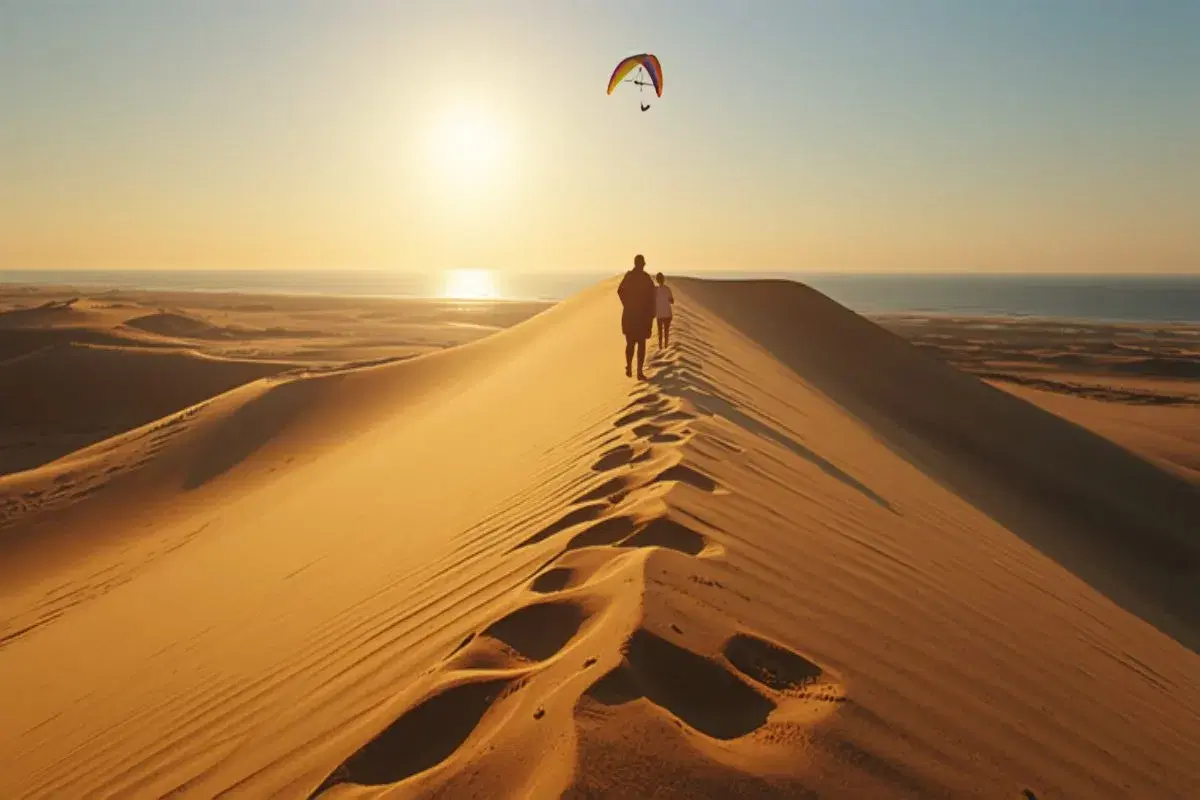
Rising out of Nags Head like a desert dropped onto a barrier island, Jockey's Ridge is the tallest active sand dune system on the Atlantic coast of the United States — and one of the most genuinely surprising places on the Outer Banks. There's no boardwalk to the top, no chairlift, no admission fee. You park, you take off your shoes, and you walk up a mountain of sand until the Atlantic Ocean appears on one side and Roanoke Sound on the other.
It's the rare OBX attraction that works for a toddler, a teenager, a hang-gliding adrenaline seeker, and a grandparent who just wants to watch the sunset — often all in the same family, on the same evening. From Grandy Cove on Currituck Sound, Jockey's Ridge is about a 35-minute drive south, making it one of the easiest half-day trips you can build into an Outer Banks week.
Here's everything you need to know before you go.
What Jockey's Ridge Actually Is
Jockey's Ridge State Park covers roughly 427 acres of shifting sand in the heart of Nags Head, just off US-158 (the bypass). The dunes themselves are what's called a medano — a huge hill of sand with no vegetation to anchor it, which is exactly why it keeps moving. The tallest peaks rise between 80 and 100 feet depending on the year, the season, and which way the wind has been blowing.
That movement is the whole story. The dunes shift a few feet every year, driven by the northeast winds in winter and southwest winds in summer. The park exists because local residents fought to protect the dune in the early 1970s when developers wanted to level it — one resident, Carolista Baum, famously stood in front of a bulldozer to stop the grading. North Carolina established the state park in 1975.
For visitors, the practical takeaway is simple: this is a real dune-climbing experience, not a manicured overlook. You earn the view.
Hiking the Dunes
There's no marked trail to the summit — you simply pick a ridgeline and climb. Most visitors start from the main parking area off Carolista Drive, where a short sand path leads from the lot up onto the dune field.
A few things worth knowing before you start up:
- The sand gets hot. In summer, midday surface temperatures can climb high enough to burn bare feet. This is the single most important planning fact about Jockey's Ridge. Go early morning or late afternoon, and bring water.
- It's farther than it looks. Reaching the tallest peak and back is roughly a mile round trip across soft sand, which is more tiring than a mile on a flat trail. Budget more time and energy than the distance suggests.
- There's a self-guided trail too. The Soundside Nature Trail is a 1.5-mile loop on the western edge of the park that winds through the maritime thicket toward Roanoke Sound — a good option if you want shade and a different perspective.
- Bring water, sunglasses, and a hat. There's no shade on the open dune, and the reflected glare off the sand is intense.
From the top on a clear day, you can see the Atlantic Ocean to the east and Roanoke Sound to the west — one of the only spots on the OBX where you can take in both at once.
Hang Gliding — The Park's Signature Activity
Jockey's Ridge is the largest hang gliding training site in the world, and for good reason: steady ocean winds, a soft sand landing, and a slope that's forgiving for beginners. If you've ever wanted to try the sport, this is arguably the best place in the country to start.
Lessons are run by Kitty Hawk Kites, which has operated at the dune for decades. A beginner package typically includes ground instruction followed by several short flights down the face of the dune, with an instructor running alongside you. You don't need any experience, and the flights are low and slow — this is foot-launched dune gliding, not jumping off a cliff.
A few notes:
- Reserve ahead in summer. Beginner lesson slots fill up, especially in July and August.
- Morning sessions often have the most reliable wind and the coolest sand.
- There's a weight range for the beginner lessons, so check the current requirements when you book.
- Kids can usually participate from around age 4 or 5 for the youngest tandem-style flights — confirm the current minimum age directly.
Even if you don't fly, watching the gliders launch off the ridge is a show in itself, and it's free.
Sandboarding the Dune
Yes — you can sandboard down Jockey's Ridge, and it's one of the most fun things families do here. But there are rules, because the dune is a protected resource.
- You need a free permit from the park to sandboard, available from the visitor center.
- Sandboarding is seasonal — it's permitted from October 1 through March 31, when cooler temperatures and the dune's winter shape make it safe. It is not allowed in the summer months.
- You bring your own board (sandboards, not snowboards, work best; rentals are available from local outfitters including Kitty Hawk Kites).
- Boarding is only allowed in designated areas, away from hang gliders and pedestrians.
If you're visiting in fall, winter, or early spring, it's absolutely worth the stop at the visitor center to grab a permit. If you're here in summer, plan your boarding for a different trip — and enjoy the dune for hiking and kite flying instead.
Sunset at Jockey's Ridge
This is the part locals don't always advertise. Jockey's Ridge is one of the best sunset spots on the entire Outer Banks. Because the dune rises high above everything around it and faces Roanoke Sound to the west, you get an unobstructed view of the sun dropping over the water — with the whole dune glowing gold around you.
In the hour before sunset, the sand cools off, the crowds thin, and families spread out across the ridge to watch. It's free, it's unforgettable, and it pairs perfectly with a late-afternoon dune hike. The park's gates typically stay open until shortly after sunset (closing times shift by season — currently the park closes around 8 or 9 p.m. in summer), so check the posted hours when you arrive and give yourself time to walk back down before dark.
Bring a blanket, a few snacks, and a camera. Kite flying at golden hour is a Jockey's Ridge tradition — the steady sound-side wind keeps a kite up effortlessly.
Practical Visitor Information
Location: 300 W Carolista Drive, Nags Head, NC — just off US-158 (the bypass) near milepost 12.
Admission: Free. There's no entrance fee for the state park.
Visitor center: Open daily with restrooms, a small museum on the dune's ecology and history, exhibits, and the desk where you pick up sandboarding permits. It's worth a quick look, especially with kids.
Restrooms and water: Available at the visitor center and main parking area. Fill your water bottles here — there's nothing on the dune.
Accessibility: A boardwalk near the visitor center leads to an elevated viewing platform with dune views for those who can't manage the soft-sand climb. The park also offers a limited-availability all-terrain wheelchair — call ahead to reserve. For more on accessible OBX outings, see our wheelchair-accessible Outer Banks guide.
Best time to visit: Early morning or the two hours before sunset. Avoid midday in summer when the sand is dangerously hot.
What to bring: Water, sunscreen, hat, sunglasses, and either sturdy sandals or the willingness to go barefoot (sneakers fill with sand instantly). A kite is optional but highly recommended.
Making It Part of Your Trip
Jockey's Ridge sits in the middle of Nags Head, which makes it easy to combine with other stops. A natural OBX day might look like this:
- Morning: Climb the dune before the sand heats up, then explore the Soundside Nature Trail.
- Midday: Head to nearby Nags Head or the Wright Brothers National Memorial in Kill Devil Hills, about 10 minutes north — fittingly, the Wright brothers tested some of their early gliders on these same Nags Head dunes.
- Afternoon: Lunch and a beach break, or a drive south to Manteo and the NC Aquarium on Roanoke Island.
- Evening: Return to Jockey's Ridge for sunset and kite flying.
If you're traveling with kids, Jockey's Ridge belongs at the top of your list — it's covered in our broader guide to the Outer Banks with kids. And because the dune is open year-round, it's a reliable highlight no matter the season, including the quieter fall and winter months when sandboarding is in full swing and the crowds disappear.
Why Grandy Cove Is a Smart Base for a Jockey's Ridge Trip
Jockey's Ridge is roughly 35 minutes south of Grandy Cove, our pet-friendly waterfront rental on Currituck Sound. Basing your trip in Grandy keeps you on the quieter, more affordable sound-side of the Outer Banks while still putting every major attraction — the dunes, the beaches, the lighthouses, the aquarium — within easy reach.
It's also a natural fit if your days are built around the water. Grandy Cove sits on Currituck Sound with a private dock and boat launch, so you can spend a morning kayaking or fishing the sound and an evening watching the sun set from the top of the East Coast's tallest dune. And because we're pet-friendly with no size restrictions, the dog comes too — though leave them in the air-conditioning during the hottest part of the day, since that hot summer sand is rough on paws just like it is on bare feet.
Ready to plan your Outer Banks week? Check our availability calendar and book direct — no platform fees, no surprises, and a waterfront base that puts Jockey's Ridge and the rest of the OBX right at your doorstep.