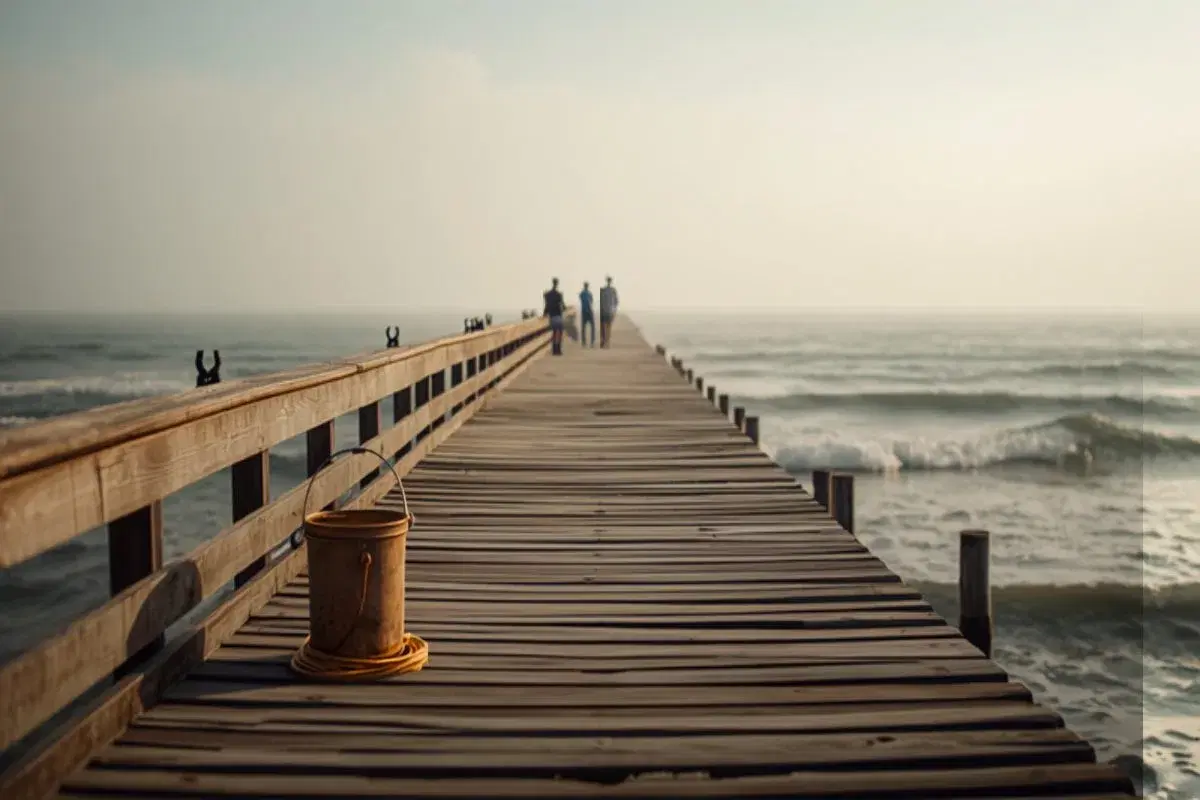
Pier fishing is the most accessible saltwater fishing on the Outer Banks. You don't need a boat, you don't need a 4WD vehicle, and in most cases you don't even need your own fishing license. You pay at the tackle shop, walk out over the breakers, and drop a line into water that would otherwise take a boat to reach.
That accessibility is why the piers are the right first stop for families and casual anglers, and why serious surf fishermen still work them hard in October. But the five ocean piers on the OBX are not interchangeable. They differ in length, construction, what's at the base, how far they reach into the fish, and how much they cost to fish. Picking the wrong one for your trip means a long drive to a crowded rail.
Here's an honest pier-by-pier breakdown, plus the tackle and timing that actually matter.
Jennette's Pier, Nags Head
7223 South Virginia Dare Trail, Nags Head
The most substantial pier on the Outer Banks and the only one built of concrete. The original wooden Jennette's dated to 1939 and was destroyed by Hurricane Isabel in 2003; the current 1,000-foot concrete structure opened in 2011 and is operated by the North Carolina Aquariums, not a private owner.
That state-run ownership changes the experience. There's an education center at the base with aquarium tanks, a public restroom that's actually maintained, wind turbines on the deck, and a separate cheap sightseeing pass if you just want to walk out without fishing. It's fully ADA accessible, which matters more than most guides mention.
Best for: First-time pier anglers, families with kids, anyone with mobility needs, people who want a clean and well-run operation
Watch for: It's the busiest pier on the beach in July and August. Weekend mornings at the end of the pier fill up early.
Drive from Grandy Cove: About 35–40 minutes
Nags Head Fishing Pier
3335 South Virginia Dare Trail, Nags Head
The classic. Built in 1947 and still standing on wooden pilings, this is the pier most people picture when they think of the Outer Banks. It runs roughly 750 feet, and the pier house includes a restaurant with a genuine ocean view, which makes it the easiest sell to a group where only half the party actually wants to fish.
The wooden deck fishes differently than concrete. Pilings hold structure, and sheepshead and black drum work the barnacles underneath through the warm months if you fish tight to the posts with fiddler crabs or sand fleas.
Best for: Traditional OBX character, groups with mixed interests, structure fishing around the pilings
Watch for: Older wooden piers take storm damage. Sections occasionally close for repair, so call ahead in the off-season.
Drive from Grandy Cove: About 35 minutes
Avalon Pier, Kill Devil Hills
2111 North Virginia Dare Trail, Kill Devil Hills
Built in 1958 and the closest ocean pier to Grandy Cove. Avalon is a working wooden pier with a tackle shop, grill, and arcade at the base. It's shorter than Jennette's, and it has a more local, less polished feel that regulars specifically prefer.
Because it's the nearest pier to the northern beaches, it's the practical choice for a pre-breakfast trip. You can be on the rail at first light and back at the house before the rest of the family is properly awake. If you're already planning a day around Kill Devil Hills, it slots in easily.
Best for: Short trips from the north, early-morning sessions, anglers who want a no-frills local pier
Watch for: Parking is tight in peak season. The lot fills by mid-morning on summer weekends.
Drive from Grandy Cove: About 25 minutes
Outer Banks Fishing Pier, South Nags Head
8901 South Old Oregon Inlet Road, Nags Head
The southernmost pier on the northern beaches, built in 1959. Its main advantage is geography: it sits closest to Oregon Inlet, and the inlet moves fish. Water pushing in and out of the inlet carries bait, and the pier catches the edge of that traffic.
Fish Heads Bar & Grill sits right at the base, which gives this pier a slightly different evening character than the others. Night fishing here in summer is productive for sharks and big bluefish.
Best for: Anglers chasing inlet-influenced fish, night sessions, king mackerel rigs in late summer
Watch for: It's a longer drive from the northern beaches than the other three, and South Nags Head has fewer services around it.
Drive from Grandy Cove: About 45 minutes
Rodanthe Pier, Hatteras Island
24251 Atlantic Drive, Rodanthe
The outlier. Rodanthe sits well south on Hatteras Island, past the Bonner Bridge and through Pea Island. It's a long drive from Currituck County, and it takes storm damage more often than the northern piers because of where it sits on the exposed elbow of the island.
It's still worth the trip in one specific window: the fall red drum run. Big drum push through in October and November, and Rodanthe's position on the narrow southern island puts it in the middle of that migration. If you're on the OBX in the fall and you're serious about drum, this is the drive to make.
Best for: Fall red drum, anglers already exploring Hatteras Island
Watch for: Verify it's open before you drive. Damage closures are a real risk. Budget most of a day.
Drive from Grandy Cove: Roughly 1 hour 20 minutes or more, depending on summer traffic through the beach towns
A Note on Kitty Hawk Pier
You'll find the old Kitty Hawk Pier referenced in older guides and on maps. It was restored as part of the Hilton Garden Inn property and functions as a private event and guest amenity rather than a public fishing pier. Don't build a morning around it. If you're basing your day in that area, the Kitty Hawk guide covers what's actually open to visitors.
Do You Need a Fishing License?
This is the single most useful thing to know, and it's the thing most visitors get wrong.
North Carolina requires a Coastal Recreational Fishing License (CRFL) for saltwater fishing. But the ocean piers hold a blanket pier license that covers everyone fishing from the structure. When you pay for a pier ticket, you're covered. No separate license purchase, no online registration, no waiting.
That exemption applies only while you're on the pier. The moment you're surf fishing from the beach, fishing the sound, or fishing from a private dock, you need your own CRFL. You can buy one online from the NC Division of Marine Fisheries or at most local tackle shops, and short-term licenses are available for visitors.
If you plan to mix pier days with beach or sound days, just buy the license. It removes the ambiguity for the whole trip.
What You'll Catch, By Season
Timing matters more on the OBX than location. The same pier can be dead in February and shoulder-to-shoulder in October.
| Season | What's running |
|---|---|
| Spring (April–June) | Sea mullet, black drum, croaker, bluefish, puffers; Spanish mackerel arriving late spring; cobia sightings in May and June |
| Summer (June–August) | Spanish mackerel, pompano, spot, croaker, flounder, sheepshead around pilings, sharks and big blues at night, king mackerel off the end |
| Fall (September–November) | The best season by a wide margin. Red drum, speckled trout, big bluefish, the October spot run, sea mullet |
| Winter (December–March) | Thin. Some piers reduce hours or close entirely. Occasional striped bass |
If you have flexibility in when you travel, come in October. The water is still warm, the crowds are gone, the spot run is on, and the drum are moving. It's the reason a lot of repeat OBX anglers stopped booking in July. Our fall on the Outer Banks guide covers what else opens up in that window.
Tackle That Actually Works
You can rent a rod at every pier, and for a first outing that's the right call. If you're bringing your own, here's the short list:
- Rod: A 7 to 9 foot medium-heavy spinning setup handles nearly everything from the rail. Bring a second, shorter rod if you plan to jig for Spanish.
- Bottom rig: A two-hook bottom rig with #4 or #6 hooks is the workhorse. Buy them pre-tied at the pier shop; they're cheap and locally correct.
- Weight: 2 to 4 ounce pyramid sinkers. Bank sinkers if you're fishing near the pilings and want to hang up less.
- Bait: Fresh shrimp and bloodworms cover most species. Fishbites synthetic strips last longer and survive pinfish. Fiddler crabs or sand fleas for sheepshead.
- Casting lures: A Gotcha plug is the standard for Spanish mackerel and bluefish. Retrieve fast.
- Cooler and a rag. Bring more water than you think you need. There's no shade on a pier.
Almost every pier has a tackle shop at the base selling exactly what's working that week. Ask the person behind the counter what came over the rail yesterday. That answer is worth more than any online report.
Pier Etiquette, Briefly
Piers are shared space with real rules, mostly unwritten:
- Don't cast over someone else's line. Cast straight out from your spot.
- Walk your fish down the rail rather than dragging it across everyone's lines.
- The end of the pier belongs to the king mackerel anglers during king season. Their rigs need room and they were there first.
- Don't leave rods unattended in a crowd.
- Clean up your bait and cut line. Monofilament left on a deck kills birds.
Fishing Closer to Home
The ocean piers are a drive from Currituck County, and they're worth it. But you don't have to make that drive every day to fish.
Grandy Cove sits directly on Currituck Sound with a private dock and boat launch. The sound is brackish and holds a completely different mix than the ocean side: largemouth bass, striped bass, catfish, and speckled trout depending on salinity and season. You can fish it from the dock at sunrise without getting in the car, which is a meaningfully different vacation than one built around a 40-minute drive each way.
The dock is also the easiest crabbing you'll find. Our Currituck Sound crabbing guide walks through drop-line crabbing from the dock, which costs almost nothing and reliably entertains kids for hours. For the wider picture on sound versus ocean fishing, charters, and the boat launch, see the Outer Banks fishing guide.
Planning Your Pier Day
A workable structure for a first pier trip:
- Check the pier's hours and status the day before. Off-season hours change and storm closures happen.
- Go at first light or the last two hours before dark. Midday in summer is hot, crowded, and slow.
- Fish a moving tide. Slack water is the least productive time to be on the rail.
- Start with a bottom rig and shrimp. Catch something, then get specific.
- Bring the non-anglers a plan. Jennette's has the education center, Nags Head Pier has the restaurant, and both beaches are right there.
The piers reward repeat visits more than one-off trips. Staying somewhere central means you can hit Avalon at dawn, come back, and still have the whole day. From Grandy you're 25 minutes from the closest pier and under an hour from four of the five.
Grandy Cove is a waterfront, pet-friendly rental on Currituck Sound with a private dock, boat launch, and easy access to every ocean pier on the northern Outer Banks.
Check availability or book direct with no platform fees.