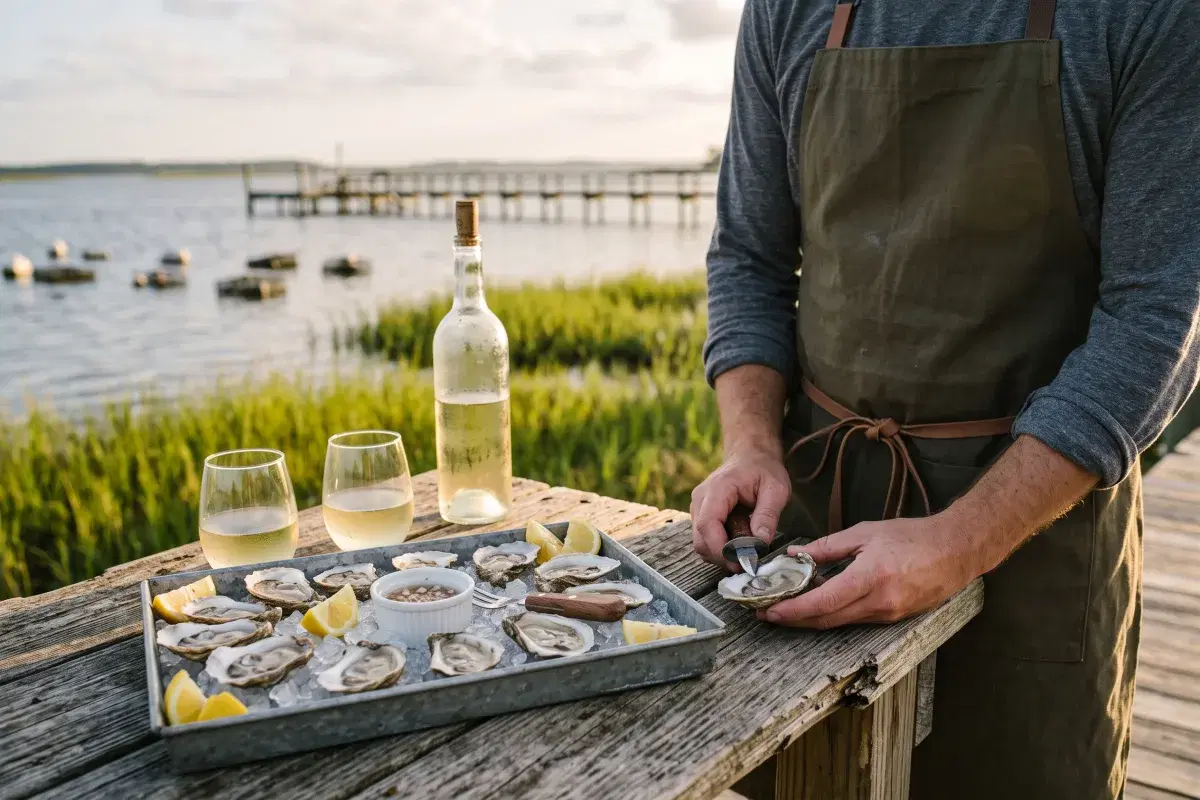
Most Outer Banks food writing is a directory. Twenty restaurants, a sentence each, no reason to pick one over another. This isn't that.
There is a real trail here — a mapped, organized one — and almost no visitors know it exists. The NC Oyster Trail connects working shellfish farms, the restaurants that serve their oysters, and the educational stops in between, along the whole North Carolina coast. Five of its farms sit on or near the Outer Banks. Two of them will put you on a boat.
Pair that with the wine and beer circuit that starts a few minutes down Caratoke Highway from Grandy, and you have something the beach strip can't offer: a full day of eating and drinking your way through the coast that doesn't depend on the ocean, the weather, or a parking space.
Start Where the Trail Actually Starts: Sanctuary Vineyards
The anchor is the easiest stop of the whole day, because it's the closest.
Sanctuary Vineyards sits at 7005 Caratoke Highway in Jarvisburg — under ten minutes down the road from Grandy Cove, on the mainland side of the Wright Memorial Bridge. It is a working coastal farm vineyard, not a themed tasting bar, and it's open daily from 10am to 6pm. Tastings run through a reservation system; call (252) 491-2387 or book online rather than assuming you can walk up on a summer Saturday.
Three things make it worth planning around rather than stopping at:
- Acoustic Sunset Thursdays. Every Thursday from early April through late September, roughly 5:30–8:30pm — live music, food trucks, and the sun going down over the vines. Free to attend, and pet friendly, which matters if you brought the dogs.
- The Vineyard Voyage. A boat cruise across Currituck Sound from Duck with tastings on board. Same water you're looking at from the dock, different angle.
- The festivals. CrabDaddy, the all-you-can-eat steamed crab and wine festival, lands on Saturday, October 10, 2026. The Big Currishuck — the all-you-can-eat steamed oyster festival, and the single best pairing of the two halves of this post — runs in November, but check the winery's event calendar for the 2026 date before you plan around it.
For the fuller picture of the mainland wine scene, including what else is on Caratoke Highway, we've covered it separately in the Outer Banks wineries guide.
The NC Oyster Trail: What It Actually Is
The NC Oyster Trail is administered by North Carolina Sea Grant and the North Carolina Coastal Federation, in partnership with the North Carolina Shellfish Growers Association. It isn't a marketing wrapper around existing restaurants — it's a working effort to connect visitors directly to the state's shellfish growers, because a farm that can sell to visitors is a farm that survives.
The trail includes four kinds of stops:
- Shellfish farm tours — go out on the water and see how oysters are actually grown
- Restaurants and markets that serve or sell North Carolina oysters
- Educational stops — aquariums, museums, ocean centers
- Oyster-shell artists and craft makers
One practical note that surprises people: farmed oysters are available year-round. The old "months with an R" rule applies to wild harvest, not to the farms. If you're here in July and want oysters, the trail has them.
The Five Outer Banks Oyster Farms
These are the growers on or near the OBX. They are spread out — Hatteras Island is a long drive from Grandy, and Ocracoke is a ferry beyond that — so treat this as a menu, not an itinerary.
Savage Inlet Oysters — Oregon Inlet Fishing Center
The closest one worth building a day around. Savage Inlet runs an oyster farm and a charter operation out of the Oregon Inlet Fishing Center, just south of Nags Head. They take guests out by boat to see how the farm works, sample oysters on the water, and buy them on the spot.
For a Grandy base, this is the realistic farm-tour option: roughly an hour and a quarter south, and it pairs naturally with a Bodie Island or south Nags Head day rather than requiring its own.
Slash Creek Oyster Company — Hatteras
The most structured tour on the list, and the one with the best storytelling. Owner Spurgeon Stowe is a fifth-generation Hatteras waterman, and the tour is as much oral history as it is aquaculture.
- Where: 57193 Olens Lane, Hatteras
- When: Tuesday, Thursday, and Friday afternoons
- How long: about an hour, starting at the dock at the Slash Creek Oyster House
- What happens: the equipment and growing process on land, then a roughly ten-minute boat ride on The Half Shell to see oysters at different growth stages
- Cost: $75 per person, or $400 for a private group of up to six
- Booking: call Spurgeon at 252-995-2045
Slash Creek sells to restaurants and markets rather than direct to the public, so the tour is how you experience them — that, or ordering their oysters where they're served.
Be honest with yourself about the drive: Hatteras village is roughly two and a half hours from Grandy each way. This is a full-day commitment, and it makes sense as part of a Hatteras day rather than a standalone errand.
Cape Hatteras Oyster Company — Hatteras Island
A father-and-son operation focused on sustainable shellfish farming. They run farm tours and sell oysters on site as well as wholesale, which makes them the one Hatteras stop where you can leave with a bag. Call ahead for an appointment rather than turning up — the hours follow the water, not a retail schedule.
Sticky Bottom Oysters — north of Hatteras Village
The farm sits northwest of Sandy Bay, just north of Hatteras village. They keep a small retail presence in Hatteras where you can place oyster orders and pick up gear — oyster knives among it, which is the most useful souvenir on the Outer Banks. Confirm current hours before driving down.
Ocracoke Mariculture — Ocracoke Island
On the trail, and genuinely good, but it is a ferry ride past Hatteras. Only worth it if you were already doing Ocracoke properly — see our Ocracoke day trip guide, which is fairly blunt about when that trip is and isn't worth the travel time.
Where to Eat Them
If you'd rather have someone else do the shucking, several Outer Banks restaurants are on the trail specifically because they serve North Carolina oysters:
- Blue Water Grill & Raw Bar, Manteo — serves both wild-caught and farmed NC oysters, prepared several ways daily. The most practical trail restaurant from a northern base, and it folds neatly into a Manteo day trip.
- The Froggy Dog Restaurant & Pub, Avon — the Hatteras Island option, useful on a Slash Creek or Cape Hatteras tour day.
- Ocracoke carries four trail restaurants — Flying Melon Café, Howard's Pub & Raw Bar, Plum Pointe Kitchen, and Ocracoke Oyster Company — which is a real argument for the overnight version of that trip rather than the day version.
The northern beaches and the Currituck mainland don't currently carry named trail restaurants, which is worth knowing before you drive somewhere expecting a plaque on the door. Plenty of good raw bars up here serve local oysters without being formally on the trail — our best seafood restaurants guide covers those.
Buying Them to Cook Yourself
This is where a rental with a real kitchen quietly wins.
Several of the farms sell direct, and the seafood markets across the OBX carry local oysters through the cool months. The Outer Banks seafood markets guide has the full where-to-buy rundown, but the short version for oysters specifically:
- Buy them closed. Live oysters are tightly shut, or close when you tap them. Discard any that stay open before cooking or stay shut after.
- Store them cup-side down, covered with a damp towel, in the fridge. Never sealed in a bag, never sitting in fresh water — both will kill them.
- Grill is the forgiving method. Set them flat on a hot grill until they pop, finish with butter and hot sauce. Shucking is a skill; the grill isn't.
If You Want to Harvest Your Own
North Carolina allows recreational oyster harvest, and it's genuinely doable from a small boat on the sound — but the rules are real and they change by proclamation:
- Season runs October 15 through March 31, unless closed earlier by proclamation
- Three-inch minimum shell length
- One bushel per person per day, not to exceed two bushels per vessel
Most importantly: the NC Division of Marine Fisheries closes specific waters to shellfish harvest based on water-quality monitoring, and those closures shift after heavy rain. Check the current DMF shellfish-closure map and the active proclamations before you harvest anything, every single time. This is the one place on the Outer Banks where "we did it last year and it was fine" is a genuinely bad reason.
The Drink Half
The beer and wine circuit deserves its own day, and we've written it up properly rather than compressing it here:
- Outer Banks breweries guide — including the fact that the oldest brewery in North Carolina is a German farm brewery on Caratoke Highway, ten minutes from Grandy, not anywhere near Asheville. The guide also covers which taprooms welcome dogs.
- Outer Banks wineries guide — Sanctuary and the rest of the Currituck mainland wine scene.
The pairing worth flagging: oysters and dry coastal white wine is not a marketing invention. Sanctuary's whites are grown in sandy soil a few miles from brackish water, which is the same reason NC oysters taste the way they do. Buy a bottle in Jarvisburg on the way out, pick up oysters on the way back, and the two things are from more or less the same place.
Building the Day
The version that actually works from a Grandy base, on a day you don't want to fight the bridge:
- Late morning — tasting at Sanctuary Vineyards, ten minutes down Caratoke Highway. Buy a bottle for later.
- Early afternoon — a Currituck farm market or roadside produce stand for whatever's in season, then a seafood market for oysters and shrimp.
- Mid-afternoon — back to the dock. Crab lines in the water if it's warm; see the crabbing guide.
- Golden hour — grill the oysters on the deck. Open the bottle.
- Evening — stay out on the dock as the light fades. On this shore the sun sets behind the house, over land. The show over the water is sunrise, so plan coffee on the dock the next morning.
The bigger-trip version: give Savage Inlet a call and put the oyster farm tour on a south-end day, or commit a full day to Hatteras with Slash Creek booked in advance and lunch at the Froggy Dog on the way back.
Why This Works Better From the Mainland
Every stop that starts this day — the vineyard, the farm markets, the oldest brewery in the state — is on the Currituck mainland, west of the bridge. Guests staying on the beach strip drive toward Grandy to reach them, through changeover-day traffic, and drive back the same way. From here they're errands, not expeditions. For more on what else is on this side, see things to do and our Currituck County rental guide.
And the last stop is always the same one. A tray of oysters, a bottle from up the road, and a private dock on the sound with the light going orange over the water.
Check availability at Grandy Cove — three bedrooms on Currituck Sound with a private dock, boat launch, and a full kitchen for whatever you bring home. Dogs welcome, no size restrictions. Book direct and skip the platform fees.