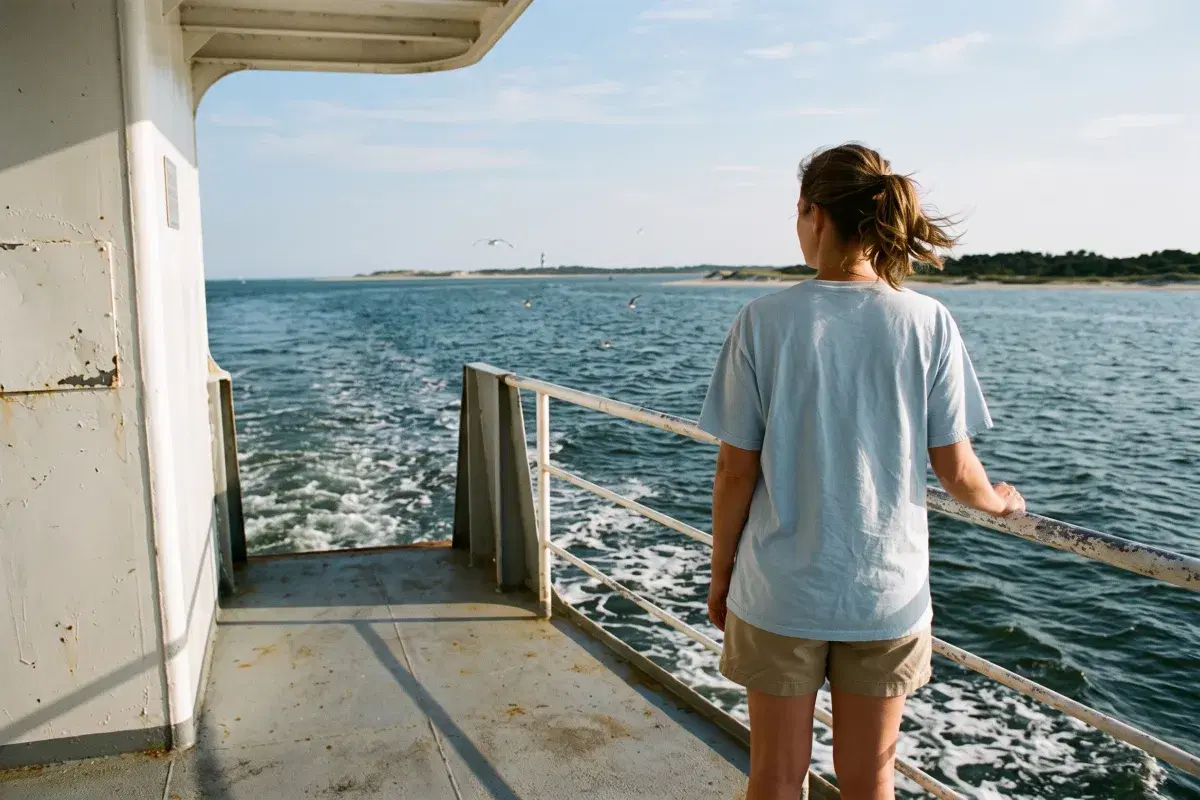
Ocracoke Island is the part of the Outer Banks that still feels like it belongs to itself. Sixteen miles of undeveloped barrier island, one village at the south end, no chain anything, no traffic lights, and a harbor full of working boats. You can only reach it by ferry or by plane. That isolation is the entire appeal — and it's also the reason a lot of people staying on the northern beaches try to squeeze it into a single day and come home wishing they hadn't.
We're going to be straight with you, because this is the kind of trip where honest arithmetic saves a vacation day. Ocracoke is genuinely worth seeing. From a base near the Wright Memorial Bridge, it is also a very long way away, and the decision to go should be made with a clear head about what the day actually costs.
The Travel Math, Before Anything Else
There is no bridge to Ocracoke. NC-12 runs south through Hatteras Island and simply stops at Hatteras village. From there, the ferry is the road.
Working backward from Ocracoke village to Grandy Cove, a one-way trip looks roughly like this:
- Grandy to Hatteras village: about two and a half hours of driving, longer on a summer Saturday when the Hatteras Island changeover traffic is on the road with you
- The Hatteras–Ocracoke crossing: about an hour on the water, plus whatever you spend in the queue
- The Ocracoke ferry landing to the village: a little over a dozen miles down NC-12, about twenty minutes
That's roughly four hours each way in a good scenario, before you have parked, eaten, or looked at anything. Eight hours of transit in a fourteen-hour day leaves you six hours on an island that deserves more, and it puts you back in the car for the long drive north at exactly the hour you'd rather be watching the sun go down.
Our 3-day OBX itinerary tells short-trip visitors to skip Hatteras and Ocracoke entirely, and we stand by that. If you have three days, spend them well on the north end. If you have five or more, Ocracoke becomes a real option — and the 5-day itinerary has a structure that makes room for it.
The Two Ferries, and Which One You Want
Most people don't realize there are two completely different ways to cross Hatteras Inlet, and picking the right one changes the shape of the day.
The Hatteras–Ocracoke vehicle ferry (free, no reservations)
This is the main route and the one most visitors take. It carries your car, it costs nothing, and it runs on a first-come, first-served basis with no reservations accepted. The crossing takes about an hour. In peak summer, boats leave roughly every thirty minutes through the middle of the day; in the shoulder seasons the gaps stretch out considerably.
Two things to know about the queue. First, "no reservations" means the line is the system — on busy summer afternoons, and especially on the return leg from Ocracoke, you can watch a boat load and leave without you. Locals go early for exactly this reason. Second, the terminal areas are thin on services, so fuel up on the mainland or in Hatteras rather than assuming you'll find a station near the ramp.
The Ocracoke Express passenger ferry (seasonal, ticketed, worth considering)
The Express is a passenger-only boat that runs between Hatteras and the Silver Lake terminal right in Ocracoke village, which is the part that matters: it drops you at the harbor instead of a dozen miles up the island. You leave your car in Hatteras and arrive on foot.
For the 2026 season it ran May 5 through September 7, Monday through Saturday with no Sunday service, at a round-trip fare of $15 per person. Children three and under ride free and bicycles cost $1. Reservations open ninety days ahead through ferry.ncdot.gov or 1-800-BY-FERRY, and while walk-ups are accepted with check-in twenty minutes before departure, reserving is the sane choice in July.
The catch is that the Express is a warm-season service. If you're reading this in fall or winter, the vehicle ferry is your only crossing, and next year's Express dates and fares should be confirmed at ncdot.gov before you build a plan around them — the schedule and pricing have both moved in recent years.
Which to pick: if you want to see the village, eat lunch on the harbor, and rent a bike, the Express is the better tool and it removes the queue anxiety from your return. If you want to reach the beaches, the pony pen, or anywhere outside the village, take your car. Our full Outer Banks ferry guide covers the longer mainland routes to Cedar Island and Swan Quarter, which matter if you're building a loop trip rather than a round trip.
What's Actually on the Island
Ocracoke is small enough to see properly and rich enough to reward a slow pace. The village clusters around Silver Lake, a near-circular natural harbor lined with docks, restaurants, and a handful of shops. The National Park Service visitor center sits near the waterfront, and the whole village is walkable or, better, bikeable.
Ocracoke Lighthouse is the one most people come for. Built in 1823, it's the oldest operating lighthouse in North Carolina and the second-oldest still working in the country — a squat, seventy-five-foot, brilliantly white tower with walls five feet thick at the base. Set expectations before you drive: you cannot climb it. The narrow ladder to the lantern and the fragile interior brickwork keep it closed to the public. The grounds are open daily and the tower is genuinely photogenic, but if climbing is what you're after, the Currituck Beach and Bodie Island lighthouses are the ones that let you up the stairs, and Currituck is twenty-five minutes from our door rather than four hours.
The British Cemetery is a small, quiet plot holding four British sailors who washed ashore after their trawler, the HMS Bedfordshire, was torpedoed by a German submarine on May 11, 1942. It takes ten minutes to visit and it is the most affecting stop on the island. The plot is tended locally and the British flag flies over it.
Springer's Point Preserve is 132 acres of maritime forest, salt marsh, and soundfront beach on the island's highest ground, threaded with a short sandy trail that opens onto the water. The site carries the Blackbeard association — Teach's Hole, the channel where he was killed in 1718, lies just offshore — and you'll pass an old cistern and a small family cemetery on the way through. Bring bug spray; it's shaded, still air.
The Ocracoke Pony Pen sits at about the midway point of the island on the Pamlico Sound side of NC-12, with a parking area and a viewing platform. These are Banker ponies, descended from the same Colonial Spanish stock as the Corolla wild horses, but they're penned rather than free-roaming — the Park Service corralled them into a 180-acre pasture in the late 1950s after the highway was paved and cars started moving at fifty miles an hour. It's a fair stop, but manage expectations: this is a fenced pasture viewing, not the beach-and-dunes encounter you get north of Corolla.
The beach is the strongest argument for the island. All of Ocracoke's ocean shoreline is Cape Hatteras National Seashore, which means no houses, no rental rows, no development of any kind behind the dune line — a rarity on the East Coast. There's a seasonally lifeguarded public beach with parking and restrooms about three miles outside the village, and if you drive past it you can have a stretch of sand largely to yourself. If you're a shell hunter, the low-traffic strands here are excellent; our shelling guide covers what to look for and when.
Practical Notes for the Day
- Go early and plan the return first. The afternoon queue leaving Ocracoke is the thing that ruins day trips. Decide which boat you intend to be on before you commit to a second stop.
- Fuel and cash. Gas on the island is limited and priced accordingly. Fill up in Hatteras.
- Bikes beat cars in the village. If you take the Express, rent a bike at the harbor. The village is flat and the roads are narrow.
- Bugs are real. Mosquitoes in the maritime forest and marsh edges are not a rumor, particularly at dusk and after rain. Our OBX mosquito guide applies here in full.
- Dogs. Ocracoke is a workable island with a dog, and leashed pets are permitted on most National Seashore beaches, but the day is long and hot and involves a lot of time in the car and on the water. Check current Park Service rules before you go — and honestly, on a trip this long, the dog may be happier at home base.
- Food and hours. Village restaurants keep seasonal hours and several close outright in the off-season. Check before you count on dinner.
Our Actual Recommendation
On a trip of four days or fewer, don't go. Spend the day on things you can reach in under an hour from the north end. You'll see more, drive less, and enjoy it more. There is no version of this day trip where you get Ocracoke and a relaxed evening.
On a trip of five days or more, go — but go properly. Leave at dawn, take the first ferries, and either accept a very full day or, better, book a night in the village. Ocracoke after the last day boat leaves is a different island: the harbor empties, the light goes gold over Silver Lake, and you finally understand why people come back every year.
Either way, the base you come home to matters. From Grandy Cove, you're on the quiet mainland side of Currituck Sound — off the barrier islands, out of the changeover-day gridlock, and close to the things on the north end that don't require a four-hour approach. The 4x4 wild horse beaches, the climbable lighthouses, the dune parks, and the water sports are all inside a forty-minute radius, and there's a private dock and boat launch waiting when you'd rather not drive anywhere at all.
Planning a longer OBX stay so Ocracoke actually fits? Check availability at Grandy Cove and book direct — no platform fees, no surprises.