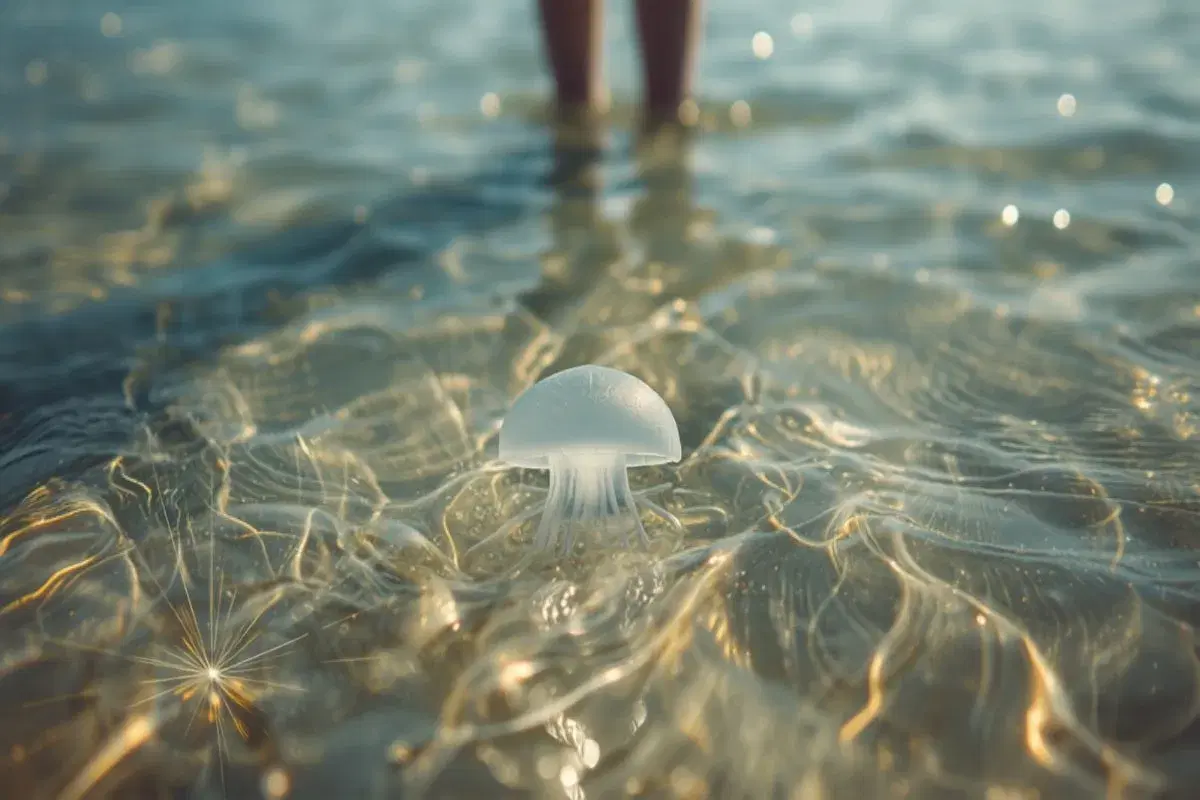
Every OBX rental company website shows the same photo: clear water, empty beach, nobody worrying about anything. That's most days. But if you're planning a trip and you've typed "jellyfish Outer Banks" into a search bar at 11pm, you want the real answer, not reassurance.
Here it is. The Outer Banks has jellyfish, stingrays, and sharks, like every stretch of Atlantic coastline. Most visitors never have an issue. The ones who do usually got stung by a sea nettle in late August, and it hurt for an hour. Knowing what's out there — and the difference between the ocean side and the sound side — is what turns this from a worry into a non-event.
A note up front: this is practical travel information, not medical advice. If a sting causes trouble breathing, chest pain, swelling beyond the sting site, or covers a large area, that's an emergency room situation, not a beach-towel situation.
The Jellyfish You'll Actually Meet
Sea nettles — the one that stings
The Atlantic sea nettle is the jellyfish responsible for nearly every OBX sting story you'll hear. It's a milky-white bell roughly the size of a fist or a small dinner plate, with long trailing tentacles that are hard to see in moving water.
Sea nettles are warm-water, late-summer animals. They're rare in June, show up in numbers in late July through September, and thin out once the water cools in October. They like calm, warm, moderately salty water, which means they can concentrate in protected coves and behind sandbars on the ocean side.
A sea nettle sting feels like a hot scratch or a nettle burn — a raised red welt in a line or streak, stinging hard for 20 to 60 minutes, then itching for a day or two. Unpleasant. Not dangerous for most people.
Moon jellies — the harmless ones
The clear, saucer-shaped jellyfish with the four-leaf-clover pattern in the middle is a moon jelly, and it's essentially harmless to humans. Their stinging cells are too weak to penetrate most skin. Kids find them fascinating. You'll see them washed up intact on the beach after a good onshore wind.
Cannonball jellies — the beach-ball ones
Firm, dome-shaped, brownish or milky with a rust-colored rim, roughly the size of a softball. Cannonball jellies are the sturdiest jellyfish you'll find on the sand and are effectively non-stinging. They wash up in numbers in fall.
Portuguese man o' war — rare, but respect it
Not technically a jellyfish, and not a normal OBX resident — the man o' war is a tropical drifter that occasionally gets pushed north on the Gulf Stream and blown ashore, usually after a stretch of persistent southeast or east wind. When they show up, they show up all at once, and lifeguards flag it.
You'll recognize one instantly: a translucent blue-purple gas-filled float that looks like a small inflated bag or bubble sitting on the sand, with a fringe of blue thread trailing from it. Do not touch it, even dead, even days later. The tentacles stay potent long after the animal dies. A man o' war sting is genuinely painful and warrants medical attention, particularly for kids or anyone with a history of allergic reactions.
Sea lice — the itchy mystery
"Sea lice" aren't lice. They're the microscopic larvae of thimble jellyfish, which get trapped under swimsuits and sting, producing an itchy rash exactly where your swimsuit sat. It's far more common in Florida than in North Carolina, but it happens here occasionally in warm late-summer water. If someone in your group comes out of the water itchy under the swimsuit and nowhere else, that's what it was. Rinse and change out of the wet suit.
What to Do If You Get Stung
The internet is full of contradictory folk remedies. Here's what actually helps:
- Get out of the water and stay calm. Most stings are minor and self-limiting.
- Rinse with seawater, not fresh water. Fresh water makes any remaining stinging cells fire. Do not rinse a sting at the outdoor shower.
- Remove tentacles without bare hands. Use the edge of a credit card, a shell, or gloved fingers. Don't rub it with sand or a towel — that fires more cells.
- Hot water beats ice. Immerse the area in water as hot as the person can comfortably tolerate (about the temperature of a hot bath, not scalding) for 20 to 45 minutes. Heat breaks down the venom proteins. This is the single most effective thing you can do.
- Vinegar for man o' war. A vinegar rinse is the standard first response for man o' war stings. For sea nettles the evidence is mixed, so hot water is the safer default.
- Skip the urine. It does nothing useful and it's mostly fresh water, which makes things worse.
Over-the-counter antihistamine and hydrocortisone cream handle the itching afterward. If the sting wraps a limb, covers a large area, involves the face, or the person shows any sign of a systemic reaction, get to urgent care. The OBX has walk-in urgent care clinics in Kitty Hawk, Kill Devil Hills, and Nags Head — worth noting the nearest one when you arrive, same as you would for a vet clinic if you're traveling with dogs.
Stingrays and the Shuffle
Southern stingrays and cownose rays are common in both the ocean shallows and the sound, and they're not remotely aggressive. Rays lie flat on the bottom, half-buried in sand, waiting for the tide. The only way to get hurt by one is to step directly on it, at which point it does what any buried animal does when a foot lands on it.
The fix is the stingray shuffle: don't lift your feet and step in shallow water — slide them forward along the bottom. A shuffling foot bumps a ray harmlessly and it swims off. A stepping foot pins it.
This matters more on the sound side than most people expect. Currituck Sound has broad, warm, shallow flats — perfect ray habitat and perfect toddler-wading habitat at the same time. Teach kids the shuffle once and it becomes automatic. A ray sting is a puncture wound plus venom; it hurts a great deal and it needs medical attention, but it is also almost entirely preventable by dragging your feet.
Sharks: The Honest Version
Yes, there are sharks off the Outer Banks. Sandbar sharks, blacktips, spinner sharks, sand tigers, and the occasional larger species all use these waters, and the OBX sits on a major migratory corridor where cold and warm currents meet off Cape Hatteras.
And yet: unprovoked shark bites in North Carolina are rare, a handful statewide in a typical year across millions of beach visits, and the great majority are minor bites to a hand, foot, or lower leg. Statistically you took a far greater risk driving over the Wright Memorial Bridge to get here.
If you want to lower an already-low risk:
- Don't swim at dawn or dusk, when sharks feed and visibility is poor
- Don't swim near people fishing — piers, jetties, and casting anglers put bait and struggling fish in the water. Give the fishing piers a wide berth
- Skip shiny jewelry, which flashes like baitfish
- Stay out of murky, churned-up water after storms
- Don't swim near visible bait schools or where birds are diving
The far more likely hazard on any OBX ocean day isn't an animal at all — it's water movement. Rip currents account for nearly every serious beach incident here, and they're worth understanding before you swim. We wrote a full guide on reading the flags and swimming safely.
Why the Sound Side Is Different
Here's the piece most beach guides skip, and it's the reason we get asked about this so often at Grandy Cove.
Currituck Sound is a low-salinity estuary. It has no direct inlet to the ocean anywhere near its northern end — the nearest connections are far to the south — so it's fed largely by rivers and rain and stays much fresher than the open Atlantic. That single fact changes what lives in it.
Sea nettles need moderately salty water to thrive. In the fresher northern reaches of Currituck Sound, they're generally uncommon compared to saltier sounds farther south like the Pamlico, and compared to the ocean side. Man o' war are an ocean animal and don't get into the sound at all. What you will find in the sound is blue crabs, largemouth bass, striped bass, and a great deal of underwater grass — which is exactly why the crabbing off a dock here is so good and why the water is warm and calm enough for small kids.
What the sound does have in abundance: rays on the flats (shuffle your feet), the occasional water snake near the marsh edge, and greenhead flies and mosquitoes in the shoulder hours — those are covered in our honest seasonal bug guide.
The practical upshot for families: a soundfront base gives you calm, waist-deep, jellyfish-light water at the private dock for the little kids and the dogs, and a 25-minute drive east to the ocean when everybody wants surf. You're not choosing between them. Our full comparison of the two sides is in soundfront vs. oceanfront.
Month-by-Month: What to Expect
| Month | Jellyfish risk | Notes |
|---|---|---|
| May–June | Very low | Water still cool; nettles haven't arrived |
| July | Low to moderate | First nettles appear late in the month |
| August | Highest | Peak sea nettle season, warmest water |
| September | Moderate to high | Nettles persist; water still warm |
| October | Low | Cooling water thins them out; cannonballs wash up |
| November–April | Effectively none | Too cold |
Wind direction matters more than the calendar on any given day. A steady onshore east wind pushes drifting animals toward the beach; a west wind blows them out. If you arrive to a beach with dozens of jellies washed up along the wrack line, that's a same-day signal to wade rather than swim, and it usually clears within a day or two once the wind shifts.
Dogs, Jellyfish, and the Beach
Dogs are curious about washed-up jellyfish, which is a problem, because a nose or a mouth is the worst possible place for a sting. Keep dogs leashed near a wrack line full of jellies, and don't let them eat one — a stung mouth or an upset stomach can ruin a vacation day fast.
Dogs are also far more likely than people to get into trouble with fishing hooks and monofilament left on the sand, and with sun-heated sand on their pads. If you're bringing dogs, our dog beach guide covers town-by-town leash rules and seasonal restrictions, and Grandy Cove's pet policy allows up to two dogs with no size restrictions.
What to Actually Pack
You don't need a marine first-aid kit. You need four small things:
- A bottle of white vinegar in the beach bag from July through September
- Antihistamine tablets and hydrocortisone cream
- Water shoes for the kids, which handle rays, shell fragments, and hot sand in one purchase
- Tweezers and a plastic card for tentacle removal
That's it. Everything else is available at any OBX drugstore, and the full trip list is in our OBX packing guide.
The Honest Summary
In a typical week on the Outer Banks, the odds are excellent that the only marine life you'll interact with is a moon jelly your kid pokes with a stick, a school of minnows in the shallows, and a pod of dolphins offshore at sunset. Late August raises the odds of a sea nettle sting to something real but manageable. Sharks are a headline, not a risk. Rays are a shuffle away from being a non-issue.
Knowing that in advance is the whole point — it lets you get in the water instead of standing on the sand wondering.
Grandy Cove sits directly on Currituck Sound with a private dock and launch, calm shallow water for kids and dogs, and the nearest ocean beaches a 25-minute drive away. Check availability and book direct — no platform fees, no surprises.