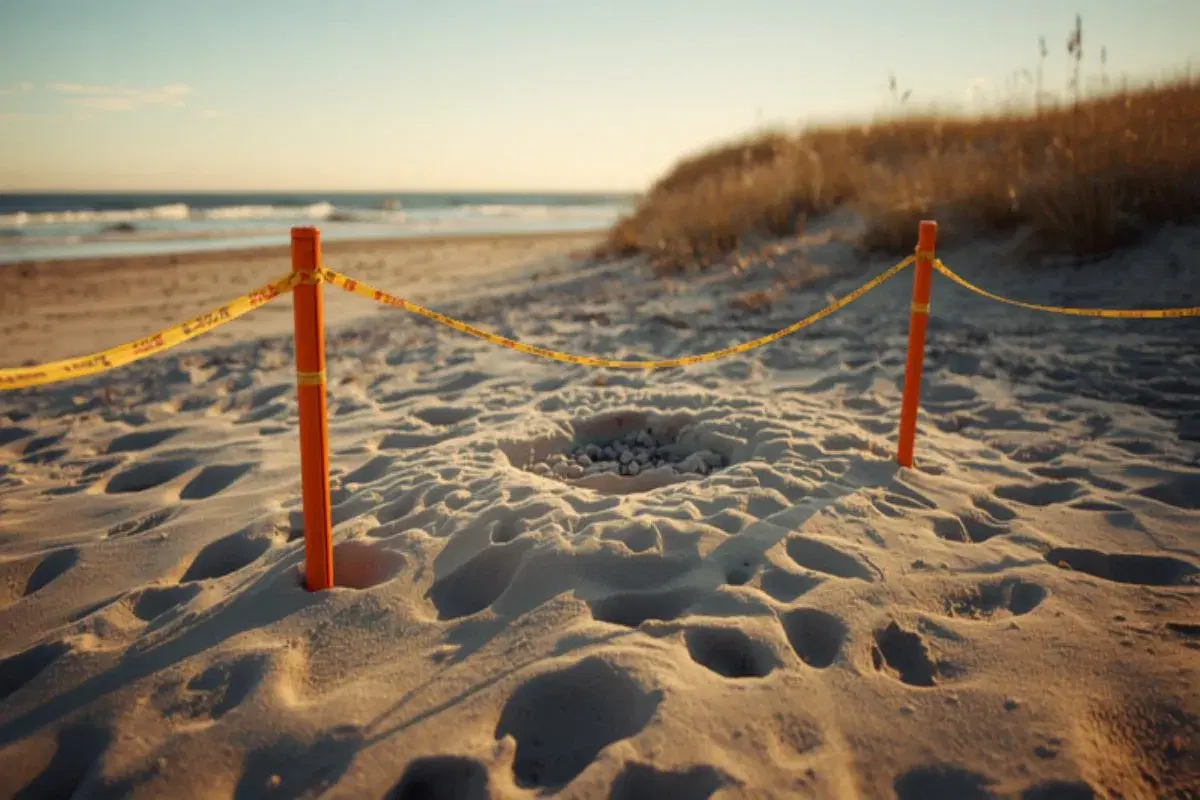
If you visit the Outer Banks between late May and October, you will almost certainly walk past a sea turtle nest. It looks like a small rectangle of sand staked out with orange posts and yellow tape, sometimes with a wire screen laid flat over the middle. Most people glance at it, take a photo, and keep walking — which is exactly right.
But there's more going on out there than the tape suggests, and a fair amount of it is governed by federal law rather than local courtesy. Here's what's actually happening on the beach during nesting season, what the rules are, and how to give yourself a realistic shot at seeing something.
Which Turtles Nest Here, and When
Four species nest on North Carolina beaches, though the numbers are lopsided.
Loggerhead — the overwhelming majority of OBX nests. An adult female runs roughly 250–350 pounds. If you see a nest on the Outer Banks, assume loggerhead unless told otherwise.
Green sea turtle — a smaller but steady share of nests, increasing in recent years.
Kemp's ridley — the rarest sea turtle in the world and an occasional OBX nester. Kemp's ridleys sometimes nest during daylight hours, which is unusual.
Leatherback — the giant of the group, over a thousand pounds in some cases. Nests here are exceptional events, not annual ones.
The rough calendar looks like this:
| Period | What's happening |
|---|---|
| Mid-May – late August | Nesting season. Females come ashore at night to dig and lay. |
| Mid-July – October | Hatching season. Nests incubate ~55–70 days, then hatchlings emerge. |
| October – November | Late boils, nest excavations, and cold-stunning season begins in the sound |
Peak overlap is late July and August, when new nests are still being laid while the June nests are hatching. If you're timing a trip around it, that window gives you the best odds of both.
What the Staked-Off Nests Mean
Nests on the northern Outer Banks are located, marked, and monitored by volunteer patrols who walk the beaches at dawn looking for crawl tracks — the wide tractor-tread pattern a female leaves coming out of the surf and going back in. If the tracks lead to a body pit, the nest gets confirmed, staked, and logged.
A few things worth knowing about those markers:
- The stakes are not the nest boundary. The eggs are typically buried 18–24 inches down, somewhere inside the marked area. The tape gives the chamber a buffer, not a precise outline.
- The flat wire screen you sometimes see is predator exclusion — it keeps foxes, raccoons, and ghost crabs from digging in. Hatchlings pass through it easily.
- Some nests get relocated. If a nest is laid below the high tide line or in a spot likely to wash out, permitted responders will move it within hours of being laid. That's the only circumstance under which anyone legally touches those eggs.
- An unmarked nest is still a nest. Not every nest gets found. This is a real argument for not digging holes in the dune line.
Sea turtles are protected under the Endangered Species Act. Disturbing a nest, handling a hatchling, or harassing a nesting female carries federal penalties. Nobody is trying to ruin your vacation with this — but it's worth understanding that "don't touch" is not a suggestion posted by a nature club.
The Rules That Actually Matter
Most of what visitors need to do comes down to three things: light, holes, and stuff left on the beach.
Lights out on the oceanfront
Hatchlings navigate to the water by moving toward the brightest, lowest horizon — which, on a dark beach, is the ocean reflecting the sky. Artificial light from an oceanfront house, a phone screen, or a flashlight beats the ocean every time, and hatchlings will crawl inland toward it until they exhaust themselves or get picked off.
If you're staying oceanfront during hatching season:
- Close blinds and curtains after dark on any window facing the beach
- Turn off deck, porch, and floodlights facing the ocean
- Skip beach bonfires and flashlights on the beach at night
- If you need light to walk, use an amber or red LED — turtles are far less sensitive to those wavelengths than to white or blue light
- No flash photography anywhere near a nest or a crawling turtle
This is one of the practical advantages of basing your trip on the sound side. At Grandy Cove, on Currituck Sound, your evening lights aren't part of anyone's hatchling problem — you just drive over to the beach during the day.
Fill in your holes
A hole dug by kids in the afternoon is a trap for a 300-pound female at 2 a.m. and a pit a hatchling can't climb out of. Every OBX beach town asks visitors to fill in holes and knock down sandcastles before leaving. It takes ninety seconds and it's the single most concrete thing a family can do.
Take your gear with you
Most Outer Banks towns have "Leave No Trace" ordinances requiring tents, chairs, canopies, and other equipment to be removed from the beach overnight — typically between sunset and sunrise, though the exact hours vary by town. Gear left out gets collected and disposed of, and more to the point, a nesting female that hits a tent frame will often turn around and go back to the water without laying. That's called a false crawl, and it's a wasted trip for an animal that only comes ashore a handful of times a season.
Bringing a Dog During Nesting Season
You can absolutely bring dogs to OBX beaches in summer — leash rules vary by town and time of year, and we cover the specifics in our guide to dog-friendly beaches on the Outer Banks. But nesting season adds a wrinkle worth taking seriously.
Dogs will dig at a nest if given the chance, and a loose dog on the beach at dawn or dusk is a genuine hazard to both nests and emerging hatchlings. Practical guidance:
- Keep the leash on near the dune line, even where off-leash hours are permitted
- Walk closer to the waterline than the dunes during summer months
- Don't let a dog investigate marked nests, staked areas, or crawl tracks
- Early morning is when volunteer patrols are working — give them room
Grandy Cove is pet-friendly with no size restrictions, and plenty of our guests bring dogs during peak nesting months. The sound-side dock and yard also give a dog somewhere to burn energy that isn't the dune line, which honestly solves most of this.
How to Actually See a Turtle
Here's the honest version: you probably won't see a nesting female, and you shouldn't plan a trip around it. Females come ashore in the dark, usually well after midnight, and beaches are closed or heavily restricted at those hours in many areas. Deliberately searching for one at night isn't legal and isn't productive.
What you realistically can see:
Crawl tracks in the morning. Get on the beach shortly after sunrise during June or July and you have a real chance of finding fresh tracks — a distinct, symmetrical set of flipper marks a couple of feet wide running up from the surf. It's one of the best reasons to be up early on the OBX anyway, and it pairs well with the light on our list of best sunrise and sunset spots.
A nest excavation. Three to five days after a nest boils, volunteers dig it out to record hatch success. These are open to the public, frequently draw a crowd, and occasionally turn up a few live stragglers that get released on the spot. They're announced with very little notice — usually a day or less — so follow the local sea turtle organizations on social media during your stay rather than trying to book anything in advance.
A hatchling boil. This is the lottery ticket. Nests boil at unpredictable hours, mostly at night, and nobody can tell you when. If you happen to be nearby when one goes, stay well back, keep every light off, and let the volunteers manage it.
Rehabilitating turtles year-round. The North Carolina Aquarium on Roanoke Island runs a sea turtle rehabilitation program, and its viewing area is the only place on the Outer Banks where you're guaranteed to see a live sea turtle up close. It's about 50 minutes south of Grandy and doubles as one of the better rainy day options on the whole island chain.
What to Do If You Find a Turtle in Trouble
If you come across a nesting female, a stranded or injured turtle, disoriented hatchlings, or an unmarked nest:
- Stay back and don't touch it. Distance is the entire point.
- Kill the lights. No flash, no flashlight, no phone screen pointed at the animal.
- Report it. Call the sea turtle stranding hotline posted at beach accesses, or notify a lifeguard, a National Park Service ranger, or the local police non-emergency line. In Cape Hatteras National Seashore, NPS staff handle turtle response directly.
- Wait if you can. Responders often need someone to point them to the exact spot.
Do not put a turtle back in the water yourself, even one that appears healthy. Strandings are usually a symptom of something — injury, illness, cold-stunning — and a well-meant release makes it impossible to help.
The Sound-Side Footnote: Terrapins
Sea turtles don't nest on Currituck Sound — they need ocean beaches. But the sound has its own turtle worth knowing about: the diamondback terrapin, a brackish-water species with a beautifully patterned shell that lives in the marsh grass and shallow creeks. They're most visible on warm mornings, heads up in the shallows, and they're a common sight from a kayak.
If you're paddling out from our dock, keep an eye out along the grass edges. Terrapins are declining across their range, largely from crab pot drowning and road mortality during nesting season, so if you're driving the causeways in June and see one crossing, slow down.
Planning a Trip Around Nesting Season
Late June through August is the strongest window — active nesting, active hatching, and the full summer beach season. September and early October are quieter but still productive for boils and excavations, with far fewer people on the beach, and they overlap nicely with our notes on the Outer Banks in fall.
For families, this is one of the better natural-history hooks the OBX offers, and it costs nothing. Kids who spend a week filling in their own holes and hunting for crawl tracks at sunrise tend to leave more invested in the place than kids who just went to the beach. Pair it with the aquarium and it's a genuinely good week — see our Outer Banks with kids guide for the rest of the itinerary.
Grandy Cove puts you 25 minutes from the nearest Dare County beaches and about an hour from the Currituck beaches in Corolla, with a private dock on the sound for the paddling half of the trip. Check availability for your dates or book direct — no platform fees, and we're happy to point you toward whichever beach access has been busiest for nests that season.