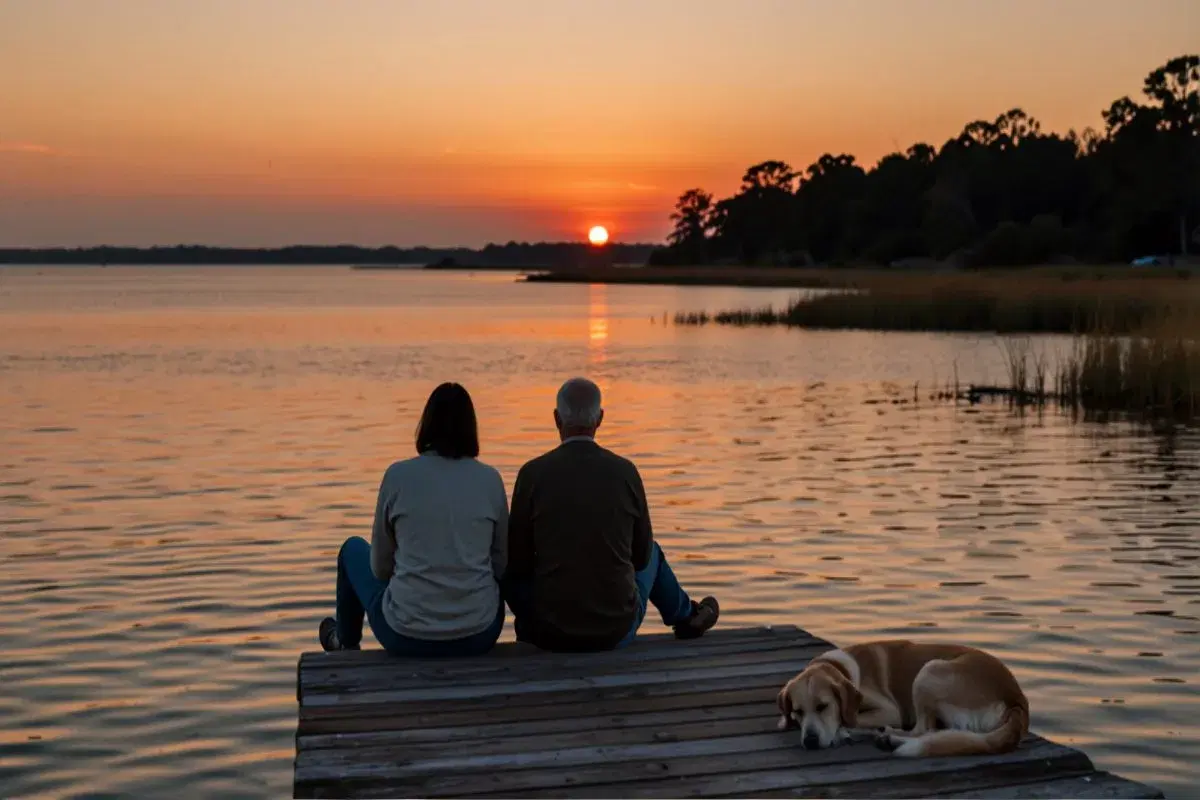
Every year, thousands of visitors haul a cooler and a blanket onto an Outer Banks beach around seven in the evening, sit down facing the water, and wait for a sunset that is never going to arrive.
The Outer Banks is a barrier island chain running roughly north to south, with the Atlantic on the east side. The ocean gets sunrise. The sun sets behind you, over the sounds on the back side of the islands. If you want the show, you have to turn around and drive fifteen minutes west.
The good news is that the sound side is a genuinely better sunset venue than an ocean beach would be. Currituck, Albemarle, and Roanoke sounds are shallow, sheltered, and often glassy in the evening once the afternoon sea breeze drops off. Flat water mirrors the sky. Low marsh grass and cypress on the far shore give you a clean silhouette line instead of a hard empty horizon. And because the sounds are wide, the color spreads across most of the visible sky rather than sitting in one small window.
Here is where to go, roughly north to south.
Currituck Sound from the Mainland Shore
The Currituck mainland, the strip of Grandy, Jarvisburg, Poplar Branch, and Point Harbor along US-158 before you reach the Wright Memorial Bridge, is the least-known sunset country on the northern Outer Banks. It is also the only stretch where the water is a two-minute walk instead of a twenty-minute drive.
This is a working waterfront rather than a tourist boardwalk, which means no crowds, no parking hunt, and no closing time. Docks, coves, and creek mouths run the length of it. Big western sky over the marsh, herons crossing to roost, and the sound going flat and pink is the standard evening here rather than a special occasion.
Practical notes: There is no public access along most of this shoreline, so this is a sunset you get from a waterfront rental, a boat ramp, or a dock. Bring bug spray from May through September. The no-see-ums come out over the marsh in the last thirty minutes of light and they are far more persistent than mosquitoes.
Duck Village Boardwalk
The single easiest sunset on the northern Outer Banks. The Duck Boardwalk runs about a mile along the sound side of Duck Village, threading through marsh grass and behind the Waterfront Shops, and the entire thing faces west across Currituck Sound.
There are benches and gazebos along the length of it, so you can arrive early, claim a spot, and watch the light change without standing. Several restaurants along the boardwalk have sound-facing decks, which is the version of this you should book a few days ahead in summer because the dinner hour fills fast.
Practical notes: Parking in Duck Village is tight from June through August. Arrive by an hour before sunset or park at the far end of the village and walk. The boardwalk is free, public, and open after dark. Full details in our Duck area guide. About 25 to 35 minutes from Grandy.
Historic Corolla Park and the Whalehead Backdrop
Historic Corolla Park in Corolla puts the Currituck Beach Lighthouse, the Whalehead club building, and a wide lawn sloping down to Currituck Sound all in one place. Sunset here comes with architecture in the frame, which is why it is the most photographed evening spot in the northern OBX.
The park grounds stay open after the buildings close, and the sound-side lawn and small boat launch area give you an unobstructed western view. The lighthouse catches the last light and glows orange for a few minutes, which is worth turning around for.
Practical notes: The buildings and lighthouse climb close well before sunset, typically late afternoon, so come for the grounds rather than the tour. Parking is free and generous. More in our Whalehead and Historic Corolla Park guide and the broader Corolla area guide. About 30 to 40 minutes from Grandy.
Kitty Hawk Bay
Kitty Hawk Bay is the sheltered pocket of water behind Kitty Hawk and Kill Devil Hills, and it is the most overlooked sunset water on the central beaches. The sound-side restaurants along the bay do a brisk sunset dinner trade, and the small residential streets that dead-end at the water give you quiet, no-crowd viewing if you are willing to walk.
The bay is shallow and protected enough that it goes mirror-flat on most calm evenings, which makes for the cleanest reflections of anywhere on this list.
Practical notes: Sound-side dining here books up in summer. Reserve several days out. See the Kitty Hawk area guide. About 20 to 25 minutes from Grandy.
Jockey's Ridge State Park
This is the marquee sunset on the entire Outer Banks, and it earns it on elevation alone. Jockey's Ridge is the tallest active sand dune system on the Atlantic coast, and from the top you are looking west over Roanoke Sound with nothing in the way. The dune itself turns gold in the last half hour, the sand cools down enough to walk barefoot, and the crowds that mob the park at midday have mostly cleared.
It is free, it is unforgettable, and it works for a group with wildly different energy levels because you can climb as far up the ridge as you want and the view is good from anywhere on the slope.
Practical notes: The park gates close shortly after sunset and the closing time shifts by season, so check the posted hours when you arrive and leave yourself time to walk back down in fading light. Soft sand is slow going. Budget twice as long as you think for the climb. Full details in our Jockey's Ridge guide. About 35 minutes from Grandy.
The Nags Head Causeway
The US-64/264 causeway between Nags Head and Roanoke Island crosses open Roanoke Sound with water on both sides. Several marinas, restaurants, and pull-offs along it face directly into the sunset, and this is where most of the sound-side dinner cruises and dolphin tours launch from.
Timing a sunset cruise out of the causeway marinas is one of the better splurges on an OBX trip, because it puts you on the water rather than looking at it. Our dolphin tour guide covers the operators along here.
Practical notes: Do not stop on the causeway shoulder itself. Use a marina lot or a restaurant. About 40 minutes from Grandy.
Manteo Waterfront and Shallowbag Bay
The Manteo waterfront boardwalk wraps the harbor at Shallowbag Bay with the Elizabeth II ship tied up in view. It is a smaller, more contained sunset than Jockey's Ridge, and the appeal is as much the town as the sky: benches, ice cream, a bookstore, and a walkable historic waterfront that stays lively into the evening.
The western view from the harbor is partly framed by Roanoke Island itself, so this is a color-in-the-sky sunset rather than a sun-touching-the-water sunset. Worth knowing before you build an evening around it.
Practical notes: Free parking within a block or two of the boardwalk. See our Manteo day trip guide. About 45 to 50 minutes from Grandy.
On the Water: Sunset Paddles and Boat Trips
The best version of an OBX sunset is not from shore at all. Currituck Sound averages only a few feet deep across huge stretches, and once the afternoon wind lays down it turns into a sheet of glass. Being out on it while the color changes is a different experience entirely, and it is quiet in a way the shoreline never quite is.
Outfitters in Corolla and Duck run guided sunset kayak and paddleboard tours through the summer. If you have your own boards or a boat, launching from a sound-side dock an hour before sunset and paddling out into open water is free and better. Our Currituck Sound kayaking guide covers launch points and conditions, and the Currituck Sound boating guide has the details for anyone bringing a motor.
One safety note: carry a light. Sound water is dark fast after the color fades, and other boats will not see a kayak without one.
When Sunset Actually Happens
Outer Banks sunset times swing by more than three and a half hours across the year. Rough guide, Eastern Time:
| Month | Approximate sunset |
|---|---|
| January | 5:10 to 5:35 p.m. |
| February | 5:40 to 6:05 p.m. |
| March | 6:10 p.m., then 7:15 p.m. after the clocks change |
| April | 7:35 to 7:50 p.m. |
| May | 7:55 to 8:15 p.m. |
| June | 8:15 to 8:25 p.m. |
| July | 8:05 to 8:20 p.m. |
| August | 7:30 to 8:00 p.m. |
| September | 6:50 to 7:25 p.m. |
| October | 6:15 to 6:45 p.m. |
| November | 4:55 to 5:15 p.m. |
| December | 4:50 to 5:00 p.m. |
Check an exact table for your dates, but plan around these two rules:
Arrive 45 minutes early. The half hour before the sun touches the horizon is usually better than the moment itself, and it gives you time to park, walk in, and settle.
Stay 20 minutes after. The best color on the sound routinely comes ten to twenty minutes after the sun is gone, when the whole western sky lights up and the flat water doubles it. Most people leave before it happens.
Seasonal Notes
Summer gives you the latest sunsets and the warmest evenings, but also haze, afternoon thunderstorms, and the most competition for parking. Clear-sky summer sunsets can actually be the flattest of the year because there are no clouds to catch color.
Fall is the best sunset season on the Outer Banks. Cooler dry air, dramatic cloud structure, fewer bugs after the first cold snap, and no crowds at any of these spots. Our fall on the Outer Banks guide makes the broader case.
Winter sunsets are the most intense of the year and the easiest to catch, since the sun is down by five and you can watch one before dinner without reorganizing your day. Cold, clear winter air over the sound produces the deep reds. See the Outer Banks in winter.
Spring brings variable skies and good color, with the trade-off that the sound-side bugs return in force by mid-May. Details in the spring OBX guide.
Bringing the Dog
Every spot on this list except the restaurant decks works with a leashed dog. The sound-side shoreline is calmer and less crowded than any ocean beach at the same hour, the shallow water is warm and easy for a dog to wade into, and evening is the coolest, most comfortable part of a summer day for a dog that has been inside.
Jockey's Ridge allows leashed dogs, but check the sand temperature with your hand before a summer climb. It stays hot long after the air cools. Our pet-friendly OBX guide and dog beaches guide cover the rules by location.
A Few Photography Notes
- Shoot the whole window, not the moment. The best frames come well before and well after the sun crosses the horizon.
- Put something in the foreground. An empty sky and an empty water line is a boring photo. A dock piling, marsh grass, a boat, a person, the lighthouse: anything that gives the eye a scale reference.
- Expose for the sky and let the foreground go dark. Silhouettes over water are almost always stronger than a properly exposed but muddy foreground.
- Turn around. East-facing light during a good sunset can be better than the sunset. Marsh and dune grass across the water go a color you will not see at any other hour.
Building an Evening Around It
The practical advantage of basing a trip on the sound side is that sunset stops being a scheduled outing. From a west-facing waterfront on Currituck Sound you are not driving anywhere for it, which means you actually see it most nights rather than the one night you organized around it.
Grandy Cove sits directly on Currituck Sound with a private dock and boat launch, sleeps six across three bedrooms, and welcomes up to two dogs with no size restrictions. You can grill on the waterfront deck while the sky changes, drop a kayak in from the dock forty minutes before the sun goes down, or drive twenty to forty minutes to any of the other spots on this list and be back before dark.
Check availability and book direct. Waterfront, pet-friendly, and facing the right direction.