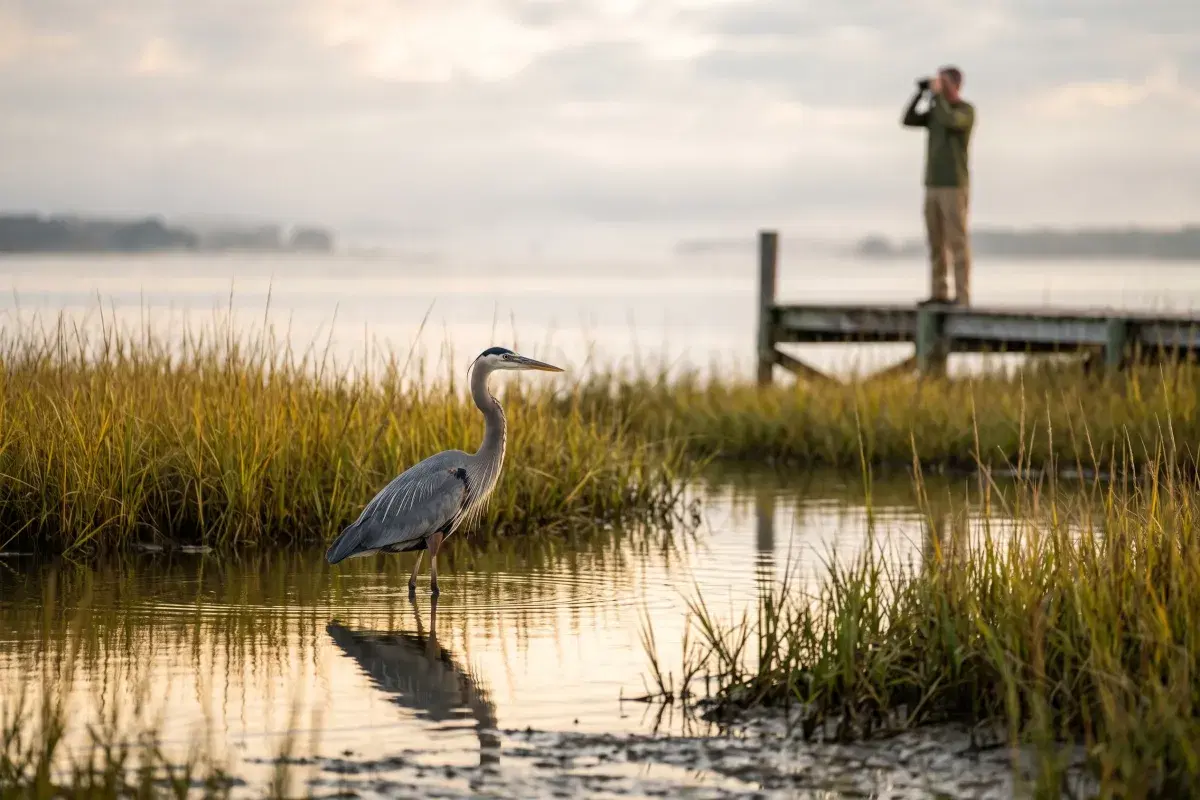
Ask most Outer Banks visitors what wildlife they saw and you'll get the same answer: the wild horses in Corolla, maybe a pod of dolphins off the beach. Both are worth seeing. But they're the two animals with a marketing budget, and chasing them means you drive past the genuinely wild parts of this coast without knowing they're there.
Thirty minutes west of the beach strip, on the Albemarle Peninsula, is one of the densest black bear populations on the East Coast and the only place on the planet where red wolves still run wild. Between there and the barrier islands sit two national wildlife refuges, a marsh boardwalk, and a hundred thousand acres of pocosin that almost nobody on vacation ever sets foot in.
This guide covers where the animals actually are, when to go, and the etiquette that matters — plus the version of all this that costs nothing, which is what happens at the water's edge on the sound side while you're drinking your coffee.
Start With the Free Show: The Sound Side
Before anyone drives anywhere, it's worth saying that the best wildlife-watching ratio on the northern OBX — animals seen per hour of effort — happens on a soundfront dock at dawn.
Currituck Sound is shallow, brackish, and lined with marsh grass, which is exactly the habitat that wading birds and their prey want. From Grandy Cove's dock, the regulars are:
- Great blue herons and great egrets, working the shallows at first light and again in the last hour of daylight. They hunt by standing still, so if you sit still too, they'll often keep working within thirty or forty feet of you.
- Ospreys, which nest on channel markers and pilings up and down the sound and fish in plain view all spring and summer. An osprey diving is the single most reliable piece of wildlife theater in Currituck County.
- Belted kingfishers, announced by a dry rattling call before you see them.
- River otters, which are genuinely common in the sound's creeks and canals and almost never seen, because they move at dawn and dusk and you have to be quiet and already outside.
- Yellow-bellied sliders and snapping turtles, hauled out on any log getting sun.
None of this requires binoculars, a tour booking, or a drive. It requires being awake before the wind picks up. That's the whole trick, and it's the same trick that makes the sunrise shelling walks work on the ocean side.
Alligator River National Wildlife Refuge: The Main Event
If you make one wildlife trip on your OBX week, make it this one.
Alligator River NWR covers more than 150,000 acres of pocosin, swamp forest, and managed wetland on the Dare County mainland, just west of Roanoke Island. It's open year-round during daylight hours, there's no entrance fee, and it's roughly an hour and fifteen minutes from Grandy — a real drive, not a quick hop, so plan it as the day rather than an errand.
Red Wolves
Alligator River is the core of the only wild red wolf population in the world. The U.S. Fish and Wildlife Service estimates roughly 15 to 17 red wolves in the wild in eastern North Carolina, spread across Dare, Hyde, Tyrrell, Beaufort, and Washington counties as what the agency calls a nonessential experimental population.
Be honest with yourself about the odds: with a population that small across that much ground, you are very unlikely to see one. People who live here go years without a confirmed sighting. What you can reliably do is stand in the country where they still exist, learn the story at the visitor center, and — in season — hear them.
Two practical things every visitor to the mainland should know:
- Drive like it matters. Vehicle strikes are a real source of mortality for a population this fragile. US-64 and the refuge roads run through wolf country, and dawn and dusk are both when wolves move and when your visibility is worst. Slow down.
- Report, don't approach. If you think you've seen a red wolf, or you find one injured or dead, call the Red Wolf Hotline at 1-855-4-WOLVES (855-496-5837) or email redwolf@fws.gov. The hotline runs 24 hours. Coyotes are common here and look similar at a distance, so the biologists want the report either way.
Black Bears
The bears are the animal you actually have a good chance of seeing. The Albemarle Peninsula supports one of the largest black bear populations in the eastern United States, and Alligator River is the easiest place to look for them.
The Murphy Peterson Wildlife Drive is the standard route — a gravel refuge road through managed wetland and farm fields where bears come out to feed. Go in the first hour after sunrise or the last two hours before sunset; a midday drive is mostly a nice look at wetland with no bears in it. Stay in your vehicle, which doubles as your blind and your safety margin, and keep the engine off and the windows down so you can hear.
The refuge also maintains two half-mile universally accessible wildlife trails, which matters if anyone in your group uses a wheelchair or has limited mobility — see our accessible OBX guide for more of the region's genuinely accessible options.
Guided Programs Worth Booking
The refuge and the Coastal Wildlife Refuge Society run guided programs that get you further in than a self-guided drive does. As of this writing:
- Open-air tram tour — weekly in summer, monthly in fall, winter, and spring. $10 for ages 13 and up, free for kids 12 and under with a paying adult. Meets at the Creef Cut Trail parking lot at US-64 and Milltail Road.
- Van tour — twice weekly in summer, small groups (about six people, ages 6 and up), $30 per person and $20 for children 12 and under.
- Canoe tour — weekly in summer, $35 per person and $20 for children, launching from the Buffalo City canoe launch and paddling blackwater canals into the interior of the refuge. Equipment is provided.
- Bear Necessities — a free 30-minute program in summer, followed by a self-guided run at the Wildlife Drive.
- Red wolf howling programs, which typically run in the warmer months, put a group out at dusk to listen for a response to a recorded howl.
Reservations for the tram, van, and canoe tours go through 252-216-9464. Schedules shift by season and by staffing, so call before you build a day around one — that number is the fastest way to find out what's actually running the week you're here.
The Gateway Visitor Center, Roanoke Island
The Coastal North Carolina National Wildlife Refuges Gateway Visitor Center on Roanoke Island is the orientation stop for the whole refuge complex — Alligator River, Pea Island, Currituck, Mackay Island, Pocosin Lakes, and seven more. Admission is free, the exhibits are genuinely good for kids (a pocosin diorama with three dozen hidden animals to find, a red wolf den to look into), and it's an excellent rainy-morning stop.
One caveat: it's volunteer-staffed, and the posted 9am–4pm weekday hours only hold when staffing allows. Call 252-473-1131 before you drive down.
Pea Island National Wildlife Refuge
South of Nags Head, past Oregon Inlet on the north end of Hatteras Island, Pea Island NWR is the barrier-island counterpart to Alligator River — and the single best bird stop on the Outer Banks, with more than 370 species recorded.
The North Pond Wildlife Trail is a 0.6-mile one-way path along the dike between the impoundments, with spotting scopes and observation platforms. It is flat, open, and hot in July, so early or late is the move. The visitor center on NC-12 posts recent sightings, which saves you a lot of guessing.
Peak is fall through early spring, when snow geese, tundra swans, and a long list of ducks pile into the impoundments. Summer is quieter for waterfowl but good for wading birds, terns, and shorebirds. It's roughly an hour and a half from Grandy, so pair it with a Hatteras day rather than driving down and back.
Bodie Island Marsh Boardwalk
The shortest good wildlife walk on the beach side is at Bodie Island Lighthouse, about an hour from Grandy. A 0.4-mile boardwalk runs from the lighthouse grounds out over the salt marsh to a bench-lined observation deck.
It takes ten minutes and delivers wading birds, seasonal waterfowl, and — depending on the month — American avocets, black skimmers, and several tern species. Leashed dogs are welcome on the boardwalk, which is not true of most wildlife trails, so it's the rare stop that works for the whole group. Our pet-friendly OBX guide covers where else dogs are actually allowed.
The Animals Everyone Already Knows About
The Corolla wild horses. Real, worth seeing, and legally protected: North Carolina law and Currituck County ordinance require you to stay at least 50 feet away, and feeding them is illegal and genuinely dangerous to the horses. We've covered the tour options and the 4WD approach in the wild horse tour guide.
Dolphins. Bottlenose dolphins are common off the beaches and in the sounds from late spring into fall, often visible from the shore in the morning. The dolphin tour guide covers the boat options if you want a closer look.
Sea turtles. Loggerheads nest on OBX beaches roughly May through August, with hatchlings emerging into the fall. The staked-off rectangles you'll walk past are federally protected nests. If you find a turtle on the beach — nesting, injured, stranded, or dead — call the N.E.S.T. 24-hour hotline at 252-441-8622 and stay back. Full detail in our sea turtle nesting guide.
Winter: When Currituck Sound Fills Up
The northern OBX's biggest wildlife spectacle happens in the coldest months, which is why almost no vacationer sees it.
Currituck Sound sits on the Atlantic Flyway, and from roughly November into February the sound and the surrounding impoundments hold enormous numbers of ducks, geese, and tundra swans. It's the same abundance that built Currituck's hunt-club era a century ago. Mackay Island NWR on Knotts Island is the marquee spot for watching it, with a wildlife drive and dike trails right along the marsh.
We go deeper on this in two places: the Currituck Sound birding guide for the watching version, and the duck hunting guide for the heritage and the season.
What to Bring
- Binoculars — 8x42 is the right general-purpose choice. One decent pair beats three cheap ones.
- A spotting scope if you're serious about the Pea Island impoundments; the birds are far out.
- Insect repellent, non-negotiable on the mainland refuges from May through September. The pocosin breeds mosquitoes and biting flies at industrial scale. Our mosquito guide has the seasonal picture.
- Long pants and closed shoes for refuge trails, ticks being the reason.
- A full tank of gas. There is no fuel on the refuge and very little on that stretch of US-64.
- Downloaded maps. Cell coverage on the Alligator River interior roads is unreliable.
The Rules That Actually Matter
Wildlife etiquette on this coast comes down to four things:
- Distance is the whole game. If an animal changes what it's doing because of you — stops feeding, lifts its head, moves off — you're too close. Back up.
- Never feed anything. A fed bear becomes a dead bear, and a fed horse becomes a road hazard.
- Stay in the vehicle on wildlife drives. It's the reason the animals tolerate the road.
- Report rather than intervene. Injured or stranded animals need the number, not your help: red wolves 855-496-5837, sea turtles 252-441-8622, and the NC Wildlife Resources Commission for everything else.
A Wildlife Day From Grandy
If you want one well-built day out of this:
- 6:00 am — coffee on the dock. Herons, egrets, and, if you're lucky and quiet, otters.
- 7:15 am — leave for the mainland.
- 8:30 am — Murphy Peterson Wildlife Drive at Alligator River, windows down, engine off, looking for bears at the field edges.
- 10:30 am — a half-mile accessible trail or the Creef Cut trail, then back east.
- 12:30 pm — Gateway Visitor Center on Roanoke Island, if it's open, and lunch in Manteo — see the Manteo day trip guide.
- 3:30 pm — Bodie Island boardwalk on the way home.
- Evening — back on the dock, which is where the day should end anyway.
Plan the Trip
The soundside is the naturalist's side of the Outer Banks. The refuges are west and south of the beach towns, the flyway runs over the sound rather than the ocean, and the herons and ospreys are simply outside every morning whether or not you booked anything.
Check availability at Grandy Cove — three bedrooms on Currituck Sound with a private dock and boat launch, and dogs welcome with no size restrictions. Book direct and skip the platform fees.