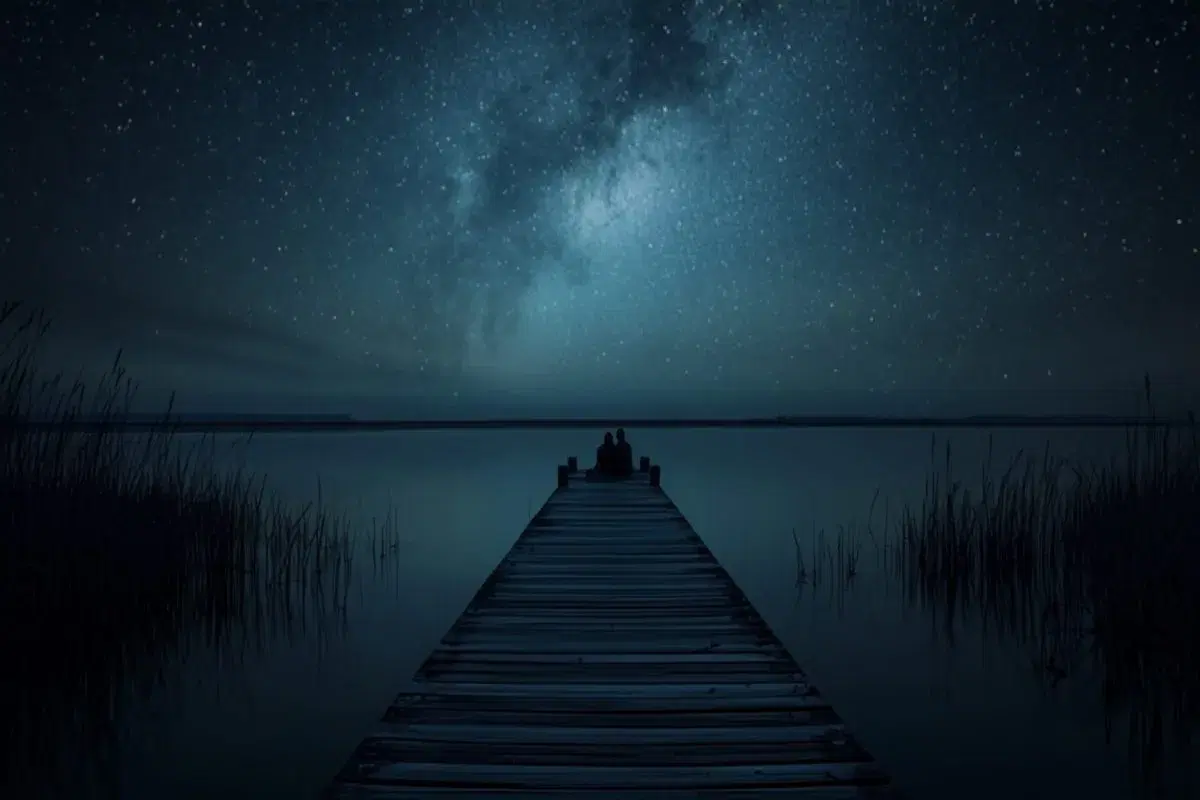
Coastal North Carolina has one geographic advantage over almost every other stargazing destination on the East Coast: half the horizon is water. No trees, no ridgelines, no subdivisions — just a flat, unobstructed sightline that runs all the way down to the edge of the sky.
The catch is light. The Outer Banks beach towns from Kitty Hawk through Nags Head are a continuous strip of streetlights, parking lot floods, and rental houses with every exterior fixture on a dusk-to-dawn sensor. Stand on the beach in Kill Devil Hills in July and you'll see the bright stuff — the Big Dipper, a planet or two, maybe a satellite — and not much else.
But you don't have to go far to fix that. The dark skies are still here. They're just on the back side of the water, and on the beaches where nobody paved anything.
Where the Dark Skies Are
The Currituck mainland shore. The western shore of Currituck Sound — Grandy, Jarvisburg, Powells Point, Coinjock — is farmland and marsh with a fraction of the development density of the beach towns. Look east across the sound and you'll see a low glow on the horizon from Corolla and Duck, but everything above about 20 degrees is clean. Look north, west, or straight up and it's genuinely dark. This is the most accessible dark sky in the region, and unlike the remote options, you can be standing in it two minutes after you close a door behind you.
Carova and the 4WD beaches. North of the pavement in Corolla, the beach runs about 11 miles to the Virginia line with no streetlights, no commercial development, and no reason for anyone to be out after dark. This is the darkest easily-reachable spot on the northern OBX. You need a four-wheel-drive vehicle and an air-down at the ramp — see our 4x4 beach driving guide before you attempt it, and understand that a night drive on soft sand is a different proposition from an afternoon one.
Mackay Island National Wildlife Refuge. Up at Knotts Island, roughly 45 minutes north of Grandy, this refuge sits at the top of the sound with almost nothing around it. The wildlife drive closes seasonally and the refuge has posted hours, so check before planning a night visit, but the causeway on NC-615 gives you water on both sides and very little light in any direction.
Cape Hatteras National Seashore. The genuine dark-sky destination on the OBX, and the reason serious astrophotographers come here at all. South of Oregon Inlet, the seashore is a protected ribbon of undeveloped barrier island, and around Frisco, Hatteras village, and Ocracoke you get skies as dark as anything on the mid-Atlantic coast. It's a long drive from the northern beaches — two hours or more from Grandy to Frisco — so treat it as a dedicated overnight rather than an evening outing.
Jockey's Ridge State Park. The dunes give you elevation and a 360-degree horizon, which is rare. The park does close at night, but it runs periodic ranger-led night programs and stargazing events during the season, which are worth checking if your trip lines up. Our Jockey's Ridge guide has the daytime details.
The Sound Side Beats the Ocean Side
This surprises people, so it's worth stating plainly: for stargazing, the sound is a better viewing platform than the ocean beach.
Three reasons. First, the water surface is calm. Currituck Sound is shallow and protected, and on a still night it goes glassy enough to double the sky in reflection — you get the stars twice. Ocean surf never does this.
Second, the ocean beach faces east into the brightest part of the coastal sky, and behind you is an entire town's worth of light spilling over the dune line. On the sound's western shore, the developed side is across several miles of open water and low on the horizon, and the dark half of the sky is directly overhead and behind you.
Third, wind. Ocean beaches are exposed, and a 15 mph onshore breeze at 10 p.m. in October makes lying on your back for an hour unpleasant. The mainland shore is more sheltered, especially in the lee of the treelines that back most of the shoreline.
The tradeoff is bugs. The marsh is mosquito country from late May through September, and standing still after dark is exactly the behavior mosquitoes are looking for. Our mosquito and biting bug guide covers what actually works — the short version is permethrin on clothing, a fan if you're on a deck, and picking a night with a breeze.
When to Go
Moon phase matters more than anything else. A full moon washes out everything but the brightest stars, and it's up all night. Plan around the new moon — the week on either side of it gives you dark skies from full dark until dawn. Any moon phase calendar or weather app will show you the dates. If you can only travel on fixed weeks, at least check whether the moon rises late or sets early on your nights; a first-quarter moon sets around midnight and hands you the rest of the night.
Season changes what's overhead. Late spring through early fall is Milky Way season on the East Coast — the bright galactic core is visible in the southern sky, best from roughly May through September. In July and August it's high enough after dark to be obvious to the naked eye from a properly dark site. Winter loses the core but gains Orion, the Pleiades, and the brightest constellations in the whole sky, and it comes with the clearest, driest air of the year. A cold January night on the sound is a genuinely underrated OBX experience — see the Outer Banks in winter for what else the off-season offers.
Meteor showers worth planning a trip around:
- Perseids — peaks around August 11–13. The most reliable summer shower, and it lands in prime beach season.
- Orionids — around October 21. Modest rates but excellent conditions; the OBX in October has some of the year's clearest air.
- Leonids — around November 17.
- Geminids — around December 13–14. The strongest shower of the year, and if you can handle a cold night, the best show the OBX sky offers.
- Quadrantids — around January 3, with a short, sharp peak.
Give your eyes time. Full dark adaptation takes 20 to 30 minutes, and one glance at a phone screen resets most of it. If you need light, use a red flashlight or red headlamp — red light preserves night vision in a way white light does not. This is the single change that most improves a stargazing night, and almost nobody does it.
Check the humidity, not just the forecast. A "clear" summer night on the coast can still be hazy enough to cut star visibility noticeably. Cooler, drier air after a front passes gives the sharpest skies of any conditions here.
What You'll Actually See
From a dark sound-side spot on a moonless night, with adapted eyes:
- The Milky Way as a distinct band across the sky, summer through early fall. From the beach towns you will not see this. From the mainland, on a good night, you will.
- Satellites, constantly. Sunlit low-orbit satellites cross overhead for the first couple of hours after dusk and again before dawn. Starlink trains — a line of evenly spaced lights moving together — are a common sight now and reliably confuse first-time viewers.
- The ISS, which passes over as an extremely bright, fast-moving point with no blinking lights. NASA's Spot the Station service will tell you exactly when it's visible from a given location.
- Planets. Venus is unmistakable low in the west after sunset or the east before dawn. Jupiter and Saturn are easy naked-eye objects when they're up, and Jupiter's four large moons are visible in ordinary binoculars.
- Bioluminescence, occasionally. This isn't a sky phenomenon, but on some warm nights the disturbed water off a dock or a paddle blade lights up blue-green. It's unpredictable and worth watching for.
Gear: What's Worth Bringing
You need almost nothing, and the thing most people buy first is the wrong thing.
Skip the telescope. A telescope shows you a tiny patch of sky at high magnification, needs setup and alignment, and is frustrating for a casual group. For a vacation, it's the wrong tool.
Bring binoculars instead. A standard 7x50 or 10x50 pair is the best stargazing purchase most people will ever make. It resolves the Pleiades into dozens of stars, shows Jupiter's moons, pulls out the Andromeda galaxy as a smudge, and turns the Milky Way into a dense field of individual points. Handheld, instant, and useful the rest of the trip for birding — the sound is a serious birding destination, as our Currituck Sound birding guide covers.
A red headlamp. Cheap, and the difference between a good night and a mediocre one.
A star chart app. Any of the point-and-identify apps work well. Turn on the app's night mode so the screen goes red.
Something to lie on. Necks give out fast. A blanket on a dock, a reclining beach chair, or an air mattress on a deck all beat standing and craning.
Layers, even in August. Coastal nights run cooler than people expect, and you're being still for an hour or more. Our OBX packing list has the rest.
Photographing the Night Sky Here
If you shoot, the sound-side shoreline is a gift: a flat foreground, reflective water, and marsh grass or a dock that gives you something in the frame besides sky.
The basics for a modern camera on a tripod: manual mode, widest available aperture, ISO 1600 to 6400, and a shutter of 15 to 20 seconds. Longer than that and stars start to trail. Focus manually on a bright star using live view zoomed in — autofocus will hunt and fail in the dark. Shoot RAW; night sky files need editing headroom.
Recent phones do a genuinely good job with their built-in night modes, and a phone braced on a dock rail or a cheap tripod will produce a usable Milky Way shot from a dark site. It will not produce one from a lit beach town, which is the whole point of driving to the dark.
Dock lines, pilings, and channel markers make far better foreground subjects than open water. So do the wild horses in Carova, if you're up there and lucky, though photographing animals at night means lights, and lights mean you should keep your distance and leave them alone.
Doing This With Kids
Stargazing is one of the few OBX activities that costs nothing, works in any season, and holds a kid's attention without a screen. A few things that make it land:
- Start before full dark. Watching the first stars appear one by one is more compelling for a young kid than walking outside into an already-full sky.
- Give them the binoculars first. The moon through binoculars — craters, terminator line, the whole thing — is the moment that hooks most children, and it works even on the bright nights you'd otherwise write off.
- Name three things and stop. Orion, the Big Dipper, and one planet is plenty. A constellation tour becomes a lecture fast.
- Meteor showers are the easiest win. Kids will sit through a lot for the chance to see one, and the Perseids in August fit the beach-week calendar perfectly.
Pair it with an earlier-in-the-day nature activity and it makes a solid theme for a day — crabbing off the dock in the afternoon, dinner, then out on the dock after dark. Our Outer Banks with kids guide has more in this vein.
An Evening Plan From the Mainland
Sunset first, if you want it. On the mainland the sun goes down behind the house, over land, so the closest sunsets over water are across the bridge at Kitty Hawk Bay or the Duck Boardwalk. Our best sunset spots guide has the specifics. Eat after, and don't turn on more lights than you need.
Then give it 90 minutes past sunset for astronomical twilight to clear out, kill the exterior lights, let your eyes adjust for half an hour, and stay out. The best hour is usually between full dark and midnight in summer, and the pre-dawn hours in winter, when the sky has rotated to bring the winter constellations high.
If you have a boat or a kayak, going out on the water on a calm, moonless night is the version of this that people remember for years — flat black water, stars in every direction, and no engine noise. Do it only in conditions you'd be comfortable in during daylight, wear a life jacket, carry a light for other boats even if you're not using it to see by, and tell someone where you're going. Our Currituck Sound boating guide and kayaking guide both cover the water itself in more detail.
Plan a Dark-Sky Trip
The practical advantage of basing on the Currituck mainland is that the dark sky isn't a destination you drive to — it's what's outside when you turn the lights off. Grandy Cove sits on the western shore of Currituck Sound with a private dock running out over the water, which is about as good a stargazing platform as this region offers: open to the east over the sound, unobstructed, and far enough from the beach towns that their glow stays low on the horizon. Dogs are welcome, and a dog on a dock at night is generally very pleased about the arrangement — the details are on our pets page.
For the best odds, target a new-moon week in late summer for the Milky Way, or mid-December for the Geminids and the year's clearest air. Check availability for your dates or book direct, and we'll tell you what the moon is doing during your stay.